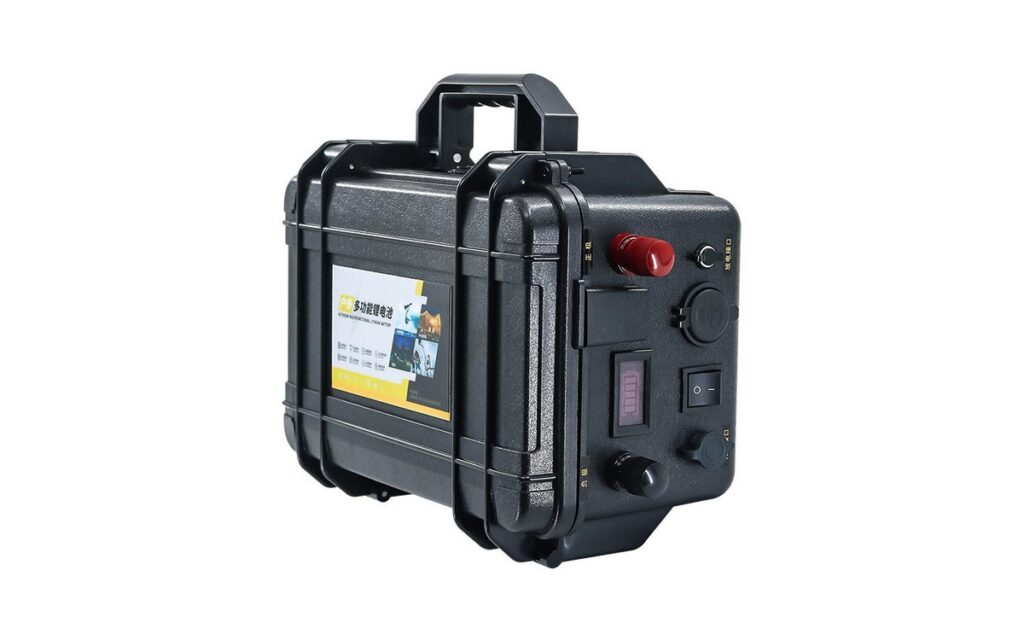
We get the same two emails almost every week. The first one is short: “Switched to lithium last month. Fished till dark, still had juice left. Best money I ever spent.” The second one is longer, usually contains the phrase “died halfway across the lake,” and ends with a question we’ve answered a hundred times: what size battery do I actually need?
If you’re putting a lithium battery on a trolling motor this season, here’s the stuff that matters — runtime math, voltage choices, and four mistakes we see people make over and over.
Start with runtime, not voltage
Most buyers start by asking “12, 24 or 36 volts?” That’s the wrong first question. The right one is: how many hours do you need on the water?
Here’s the math nobody puts on the box. A battery’s usable energy is amp-hours times voltage, times how much you can actually drain. A 100Ah lithium at 12.8V gives you roughly 1,280 watt-hours — and unlike lead-acid, you can use about 90% of that without hurting it.
A typical 55-lb thrust motor pulls around 25–30 amps at a normal cruising setting (full speed spikes higher). So 1,280Wh ÷ about 330W draw ≈ 3.5 to 4.5 hours of real fishing, depending on wind, current, and how heavy your foot is on the pedal.
Want a full day plus reserve? Go bigger or go 24V. That’s it. Everything else is detail.
12V vs 24V vs 36V: pick by boat, not by habit
12V is for smaller boats and lighter use — a 12–16 ft aluminum hull running a 45–55 lb motor, half-day trips. One 100Ah battery, simple wiring, done.
24V is the sweet spot most anglers end up at. Two 12V batteries in series (or a single 24V unit, which is what we usually recommend — fewer connections, fewer failure points). You get double the voltage, which means half the current for the same thrust: less heat, less voltage sag, and noticeably more efficient over a long day.
36V is tournament territory — big boats, 80+ lb thrust, running all day against wind. It’s also the setup where cheap lead-acid setups fall apart fastest, because you’re burning through three batteries a season.
One sizing note people miss: doubling voltage does not double your runtime. It doubles your power. Runtime comes from total watt-hours, which means total amp-hours across all batteries. Two 100Ah batteries wired for 24V still give you 100Ah “at 24V” — that’s 2,560Wh. Think in Wh, not Ah, and you’ll never size wrong.
Why everyone is switching to lithium (it’s not just the weight)
OK, it’s partly the weight. A 100Ah lead-acid deep cycle tips the scales at around 30 kg. Our 100Ah lithium trolling model weighs about 12 kg. On a small boat, dropping 18 kg off the stern changes how the hull sits, how it planes, and how tired you are after loading it into the truck.
But the bigger deal is usable capacity. A “100Ah” lead-acid battery gives you maybe 50Ah before you’re damaging it — the classic 50% discharge rule. So you paid for 100Ah and got 50. Lithium gives you 90%+ every cycle, doesn’t care if you run it down to 20%, and doesn’t sulk if it sits at partial charge over winter.
And then there’s lifespan. A decent LiFePO4 pack runs 4,000+ cycles. A lead-acid set, treated well, gives you 500–800. That gap is why tournament guys made the switch years ago and never looked back.
Four mistakes we see all the time
1. Keeping the old charger. Lead-acid chargers will cook a lithium battery — wrong voltage profile, no balancing stage. If your charger doesn’t have a lithium mode (14.2–14.6V, ideally with a balance/float stage), replace it. It’s the cheapest way to protect an expensive battery.
2. Ignoring the BMS discharge rating. A trolling motor pulls a big inrush of current the moment you hit the pedal. If the battery’s BMS can’t handle it, you get a shutdown — usually right when you’re drifting toward rocks. Check the continuous discharge rating, not just the amp-hours. (Ours is 100A continuous, which is why it doesn’t flinch at a 55–70 lb motor.)
3. Mismatched batteries in series. Running two 12V units as 24V works fine — but only if they’re the same capacity, same age, and same state of charge. Mix a new one with a two-year-old one and the older battery drags the whole string down. If that sounds like a hassle, a single 24V battery sidesteps it entirely.
4. Cooking the battery in a sealed compartment. Lithium doesn’t vent like lead-acid, so people assume it can live anywhere. It can’t — sustained heat above 45°C makes the BMS pull power to protect itself. Keep the compartment vented, and don’t stack it right against a hot livewell pump.
Quick answers
Can I keep my old charger? Only if it has a lithium profile. Most older units don’t. A basic 10–20A lithium charger costs less than one ruined battery.
12V or 24V for a 55 lb motor? On a small aluminum boat, 12V with a good 100Ah works fine. If your boat is 17 ft or bigger, or you fish full days in wind, go 24V — you’ll use about half the current for the same thrust, which means less heat and more margin.
How long will a 100Ah lithium actually last? At a typical cruising draw of 25–30A, expect 4 to 6 hours with reserve left. Trolling hard against wind? Closer to 3. That’s the honest number — anyone promising 10 hours is measuring a different boat.
If you’re not sure what fits your setup, send us your motor’s model or a photo of the spec plate — we’ll tell you what to run, even if it’s not our battery. Our 100Ah trolling model covers most 12V setups at 12 kg with a 100A BMS, and the full lithium range goes up from there.