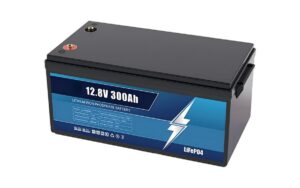
12V 100Ah LiFePO4 at a Glance
| Question | Quick answer |
|---|---|
| 12V 100Ah LiFePO4 battery weight | Typically 10–13 kg, depending on case and BMS |
| Nominal energy | 1.28 kWh (1,280 Wh) |
| Typical applications | RV, marine, solar and trolling motor systems |
| What to check | Size, discharge current, Bluetooth, low-temperature charging, warranty |
First, what 100Ah actually means
100Ah at 12.8V is about 1,280 watt-hours. 1.28 kWh (convert any battery with our Ah to kWh calculator). Marketing pages rarely translate that, so here it is in real terms: For the full model range and sizing tables, see our 12V 100Ah trolling motor battery.
- List every load in watts and multiply by expected operating hours.
- Include inverter, wiring and conversion losses.
- Keep reserve capacity for temperature, aging and unexpected loads.
Usable energy depends on the chemistry, specified depth of discharge, BMS limits, load current, temperature and system efficiency. Compare batteries under the same operating assumptions rather than using the Ah label alone.
The weight is the part you’ll notice every day
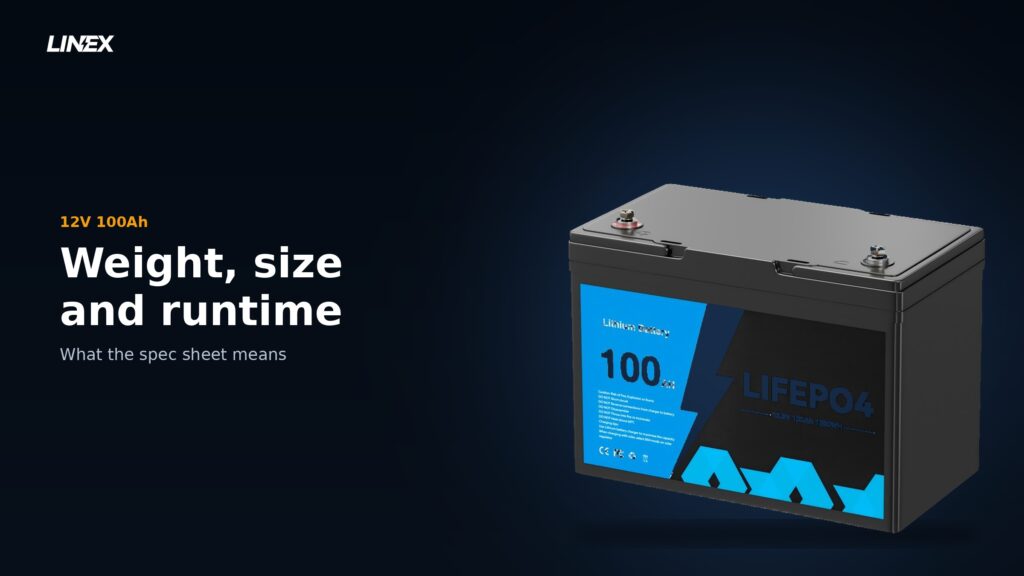
Here are the real numbers, no rounding tricks. Our 12V 100Ah LiFePO4 weighs about 10kg (22 lb) and measures 332 × 172 × 218 mm. A flooded or AGM battery with the same 100Ah label weighs around 30kg (66 lb).
Twenty kilos. If you’ve ever lugged a dead lead-acid battery out of a boat locker or a caravan compartment to trickle-charge it in the garage, you already know what that number is worth. On a boat, 20kg off the stern changes how she sits in the water. In a van build, it’s a decent chunk of your payload budget back.
Same footprint, third of the weight. That’s most of the story right there.
| Battery | Chemistry | Typical finished weight |
|---|---|---|
| 12V 100Ah | LiFePO4 | 10–13 kg (LINEX 12.8V 100Ah: ~10 kg) |
| 12V 100Ah | AGM | 30–33 kg |
| 12V 100Ah | Flooded lead-acid | 28–31 kg |
| 12V 200Ah | LiFePO4 | 21–26 kg |
| 12V 200Ah | AGM | 58–62 kg |
| 24V 100Ah | LiFePO4 | 20–26 kg |
| 48V 100Ah (rack) | LiFePO4 | 42–45 kg |
Weights are typical for finished packs and move with case material, BMS, terminals and internal layout. Always confirm the figure on the model datasheet. Per kWh stored, LiFePO4 lands around 8–12 kg/kWh, while lead-acid sits near 23–26 kg/kWh. For the full model range and sizing tables, see our 24V lithium battery range.
100Ah weight and size comparison
| Model | Energy | Weight (kg) | Weight (lb) | Dimensions (mm) | Typical use |
|---|---|---|---|---|---|
| 12V 100Ah standard | 1.28kWh | 10 | 22.0 | 332 x 172 x 218 | RV, marine house bank |
| 12V 100Ah thin | 1.28kWh | 11.5 | 25.4 | 395 x 285 x 110 | Narrow RV compartments |
| 12V 100Ah deep cycle | 1.28kWh | 12 | 26.5 | 330 x 310 x 155 | Trolling motor, deck locker |
| 24V 100Ah | 2.56kWh | 22 | 48.5 | 524 x 245 x 220 | 24V inverters, boats |
| 12V 300Ah ultra slim | 3.84kWh | 35 | 77.2 | 944 x 336 x 81 | Under-seat, van floors |
The 100Ah label does not fix the weight. Three 12V 100Ah cases in our range weigh 10kg, 11.5kg and 12kg because the case, terminals and BMS differ. A 24V 100Ah pack doubles the energy to 2.56kWh and lands at 22kg, which is still lighter than two 12V 100Ah units plus cabling.
How long will it actually last?
Our battery is rated for 6,000 cycles at 80% depth of discharge. Translate that into life:
- The published rating is 6,000 cycles at 25°C and 80% depth of discharge.
- Actual service life changes with temperature, current, charge profile and storage conditions.
- Compare suppliers using the same test conditions rather than cycle count alone.
One honest caveat: that cycle number assumes the battery isn’t cooked. Keep it out of direct engine-room heat above 60°C and treat the charge profile with a little respect, and the chemistry will do its part.
Five questions worth asking before you buy any 100Ah lithium
1. Will it fit. Actually fit? Measure the tray’s length, width and height, and leave a couple of centimetres for terminals and cables. 332 × 172 × 218 mm covers a lot of standard Group 31 trays, but check before you order, not after. If your compartment is shallower than a standard tray, the Ultra Slim 12V 100Ah keeps the same 100Ah in a case just 61.5 mm thick. For the full model range and sizing tables, see our battery types and sizes guide.
2. Is the BMS rated for your load? The model publishes a 100A maximum continuous discharge current and 1,280W maximum continuous power. Check inverter efficiency, surge demand, cable size and protection rather than relying on the Ah rating.
3. Where will the charge come from? The specification lists 20A standard, 50A recommended and 100A maximum charging current. Calculate recharge time from the actual charger output, system losses and available solar conditions.
4. Will it see cold weather? LiFePO4 shouldn’t be charged below 0°C. If you camp or work in freezing conditions, either keep the battery in a heated space or ask us about low-temperature options. Discharging in the cold is fine. It’s the charging that needs care.
5. Can you expand later? If you think you’ll add a second battery down the road, buy the same model and age-match it. Mixing capacities or brands in series is the classic mistake that quietly halves the life of both. Or skip the pairing question entirely: the 12V 200Ah doubles the energy in a single unit.
Quick answers
Can I run a fridge and lights? Calculate each load in watt-hours and compare the total with usable battery energy after losses and reserve. Appliance duty cycle and ambient temperature can change the result substantially.
Can it be installed inside a caravan or cabin? Follow the model installation instructions and local rules. Provide secure mounting, cable protection, service clearance and the specified temperature environment; do not treat the enclosure rating as approval for every location.
What about charging from the alternator? With a DC-DC charger, fine. Straight off a dumb alternator circuit, no. You’ll need the correct lithium profile.
Need a 12V 100Ah battery for an RV, marine or distribution project? Send us your required dimensions, quantity and market. We’ll confirm the case size, BMS rating and terminal layout for your build. Still sizing a setup? Tell us what you’re running and how long it needs to last; we’ll tell you honestly whether one 100Ah is enough. Our 12V 100Ah LiFePO4 page has the full spec sheet, and the wider 12V/24V range covers everything from 10Ah up to 300Ah. You can also browse all our 12V batteries in one place.
100Ah battery weight: FAQ
A 12V 100Ah LiFePO4 battery typically weighs 10–13 kg. An AGM or flooded lead-acid battery with the same 100Ah label weighs 28–33 kg, because lead-acid stores roughly a third of the energy per kilogram. Weight varies with case material, BMS and terminals.
About 10–13 kg at 12V, 20–26 kg at 24V and 42–45 kg for a 48V rack pack. The same 100Ah carries two or four times the energy at higher voltage. The LINEX 12.8V 100Ah model weighs approximately 10 kg.
LiFePO4 stores about 90–120Wh per kilogram, while lead-acid stores roughly 30–40Wh/kg. For the same 1.28kWh, that means about 10–13 kg of lithium pack instead of 28–33 kg of lead-acid battery, which matters for RV payload, boat trim and installation handling.
A 12V 200Ah LiFePO4 pack is usually 21–26 kg, and a 12V 300Ah pack roughly 31–38 kg. Doubling capacity roughly doubles weight, so plan mounting and lifting before you order, or split the bank into two batteries you can handle.
No. Weight mostly reflects chemistry and case design, not quality. Compare cells, BMS limits, cycle-life test conditions, certifications (UN38.3, CE, RoHS) and inspection reports instead of using weight as a proxy for build quality.
A 12V 100Ah LiFePO4 battery weighs about 22–29 lb (10–13 kg). A lead-acid battery with the same 100Ah rating is roughly 62–73 lb (28–33 kg), so the lithium pack saves about 40 lb per battery. Worth checking against your RV payload or boat trim before you buy.