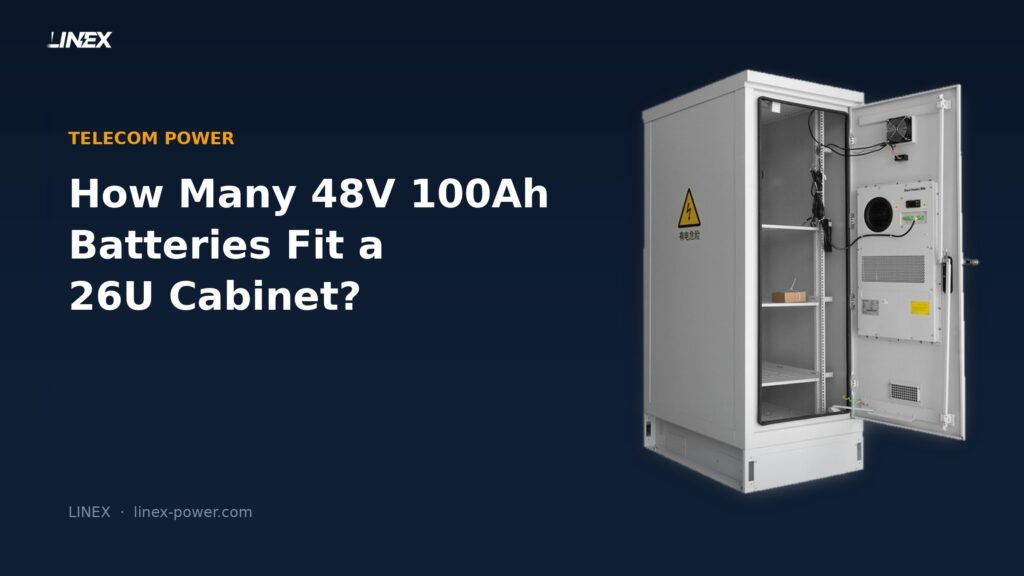
A 26U cabinet is a fixed envelope, and the battery count is decided by three limits: vertical rack space, usable depth and structural weight. The first is simple arithmetic. The other two are where most site plans fail, because a module that fits the U count can still be too deep for the enclosure or too heavy for the shelf.
This guide uses the published dimensions of the LINEX 48V rack series and the 6U–26U outdoor cabinet range. For enclosure options, start with the telecom battery cabinet supplier page, then confirm the battery count below. For the full model range and sizing tables, see our telecom battery backup guide.
Related tool: Ah to kWh calculator. Convert amp-hours to kilowatt-hours for 12V, 24V, 48V and 51.2V batteries.
What Is the Rack-Unit Math?
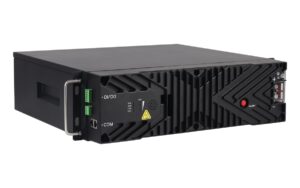
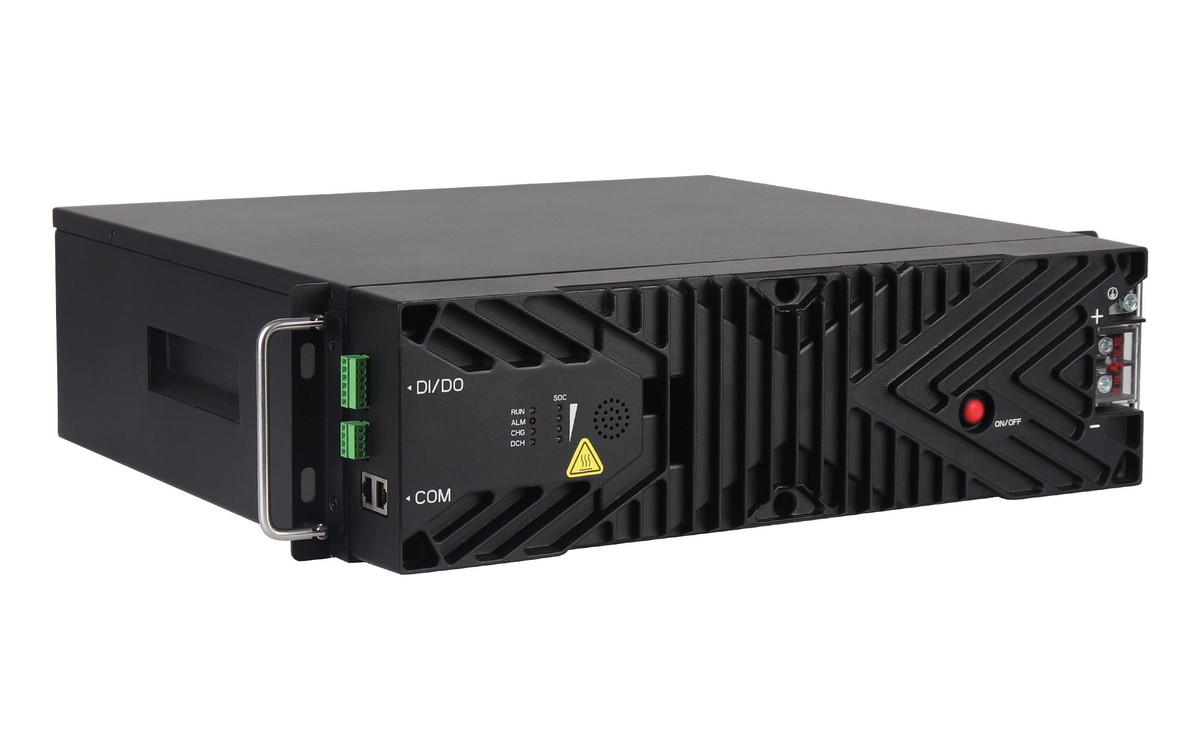
A 26U cabinet provides 26 rack units. The 48V 100Ah module is 3U high, or 133mm on the datasheet, so the division is straightforward: 26 ÷ 3 = 8.67. Eight modules use 24U and leave 2U. Nine modules need 27U, which is one unit more than the cabinet has.
The module is 442mm wide and 420mm deep, or 482mm deep once handles and terminals are included. That width sits inside the 19-inch rack standard used by the cabinet, so width is not the constraint. Height, depth and weight are.
| Specification | 48V 50Ah | 48V 100Ah | 48V 150Ah | 48V 200Ah |
|---|---|---|---|---|
| Nominal energy | 2.4 kWh | 4.8 kWh | 7.2 kWh | 9.6 kWh |
| Rack height | 3U | 3U | 4U | 4U |
| Dimensions (W × D × H) | 483 × 325 × 133mm | 442 × 420 × 133mm | 482 × 440 × 178mm | 482 × 610 × 178mm |
| Weight | 29kg | 43kg | 60kg | 78kg |
| Max charge / discharge | 50A / 50A | 100A / 100A | 150A / 150A | 100A / 100A |
| Cycle life | 6,000 at 80% DoD | 6,000 at 80% DoD | 6,000 at 80% DoD | 6,000 at 80% DoD |
| Communication | RS485 / RS232 | RS485 / RS232 | RS485 / RS232 | RS485 / RS232 |
The 100Ah and 50Ah modules share a 3U height, so a cabinet filled only with 50Ah units would hold the same eight modules but only 19.2kWh. The 150Ah and 200Ah modules are 4U, which changes the count: 26 ÷ 4 = 6.5, so six modules fit with 2U left over.
How Much Space Do the Rectifier and Breakers Need?
Eight batteries leave exactly 2U. That is not a realistic installation allowance. A rectifier shelf, DC distribution, breakers, cable entry and some blanking for airflow all need vertical space, and the battery terminals need room to bend without stressing the lugs.
Most projects reserve 3–6U for the rest of the power system. The table below converts that reservation into a working battery count. It is arithmetic, not a layout drawing: confirm the actual rectifier height and breaker arrangement before fixing the enclosure order.
| Space reserved for rectifier, distribution and cable management | Batteries fitted | Rack space used | Spare U | Nominal energy | Battery weight |
|---|---|---|---|---|---|
| 2U | 8 | 24U | 2U | 38.4 kWh | 344kg |
| 5U | 7 | 21U | 5U | 33.6 kWh | 301kg |
| 8U | 6 | 18U | 8U | 28.8 kWh | 258kg |
The middle row is the usual compromise for a 26U site: seven 100Ah modules, 33.6kWh nominal and 5U for the rectifier, breakers and cable management. If the site needs a larger rectifier or a separate DC distribution panel, the six-module row is the safer plan.
Will the Cabinet Take the Module’s Depth and Weight?
The outdoor cabinet range is offered in 600 × 450mm and 600 × 600mm footprints. Those are external dimensions, and the cabinet also carries 45mm EPS insulation plus door hardware, so the usable internal depth is smaller than the footprint figure.
The 100Ah module is 420mm deep and reaches 482mm with handles and terminals. A 450mm-deep cabinet cannot accept that installed depth. Specify the 600 × 600mm footprint for the 100Ah module and confirm the usable depth with the factory before the order is released, because cable bend radius and terminal clearance still have to fit behind the door.
Depth becomes more critical with the 200Ah module, which is 610mm deep. It needs the 600 × 600mm cabinet and should be checked against the internal depth rather than the external label. The 100Ah module is the better match for a 26U cabinet precisely because it leaves more depth margin per kWh. The full enclosure specification is on the IP65 outdoor telecom cabinet product page.
Weight is the second physical limit. Each 100Ah module weighs 43kg, so eight modules weigh 344kg, seven weigh 301kg and six weigh 258kg, before the cabinet, rectifier, breakers and cabling are added. That load has to be carried by the cabinet structure and by the floor or pad beneath it.
The cabinet datasheet does not state a universal shelf load rating, so the project should confirm the rating for the exact configuration. Mount the battery modules in the lowest available positions, use the cabinet’s adjustable brackets to support each module, and keep the heaviest units low. A 43kg module is a two-person lift; plan access for a lift or a temporary platform if the cabinet is on a raised pad.
How Should the Bank Be Wired and Monitored?
The 100Ah module supports up to 100A charge and discharge at 25°C, with RS485 and RS232 communication. Eight modules in parallel are a large bank, so the parallel design has to be checked as a system rather than assembled unit by unit. Use identical models, similar age and matched firmware, equal cable lengths to the busbar, and a breaker or fuse per string.
Confirm the BMS parallel limit for the exact model before committing to eight units. The datasheet gives the per-module current and communication interface, not a maximum bank size. The rectifier settings also have to match the battery: 53.3V equalization, 51.0V float and 40.5V discharge cutoff. A rectifier left on a lead-acid profile will not charge the bank correctly.
For a mixed-capacity choice, read the 48V 100Ah vs 200Ah comparison. The 200Ah module gives 9.6kWh in one 4U case, but it weighs 78kg and is 610mm deep.
Frequently asked questions
No. Nine modules at 3U each need 27U, which is 1U more than a 26U cabinet provides. The maximum is eight modules if the entire rack is given to batteries, and six or seven once a rectifier and distribution are included.
Eight modules give 38.4kWh nominal, because each 48V 100Ah module stores 4.8kWh. At 80% depth of discharge the usable energy is 30.7kWh. A practical seven-module installation gives 33.6kWh nominal and 26.9kWh usable.
Eight 100Ah modules weigh 344kg, seven weigh 301kg and six weigh 258kg. Add the cabinet, rectifier, breakers and cabling, then confirm the floor or pad load rating and the cabinet’s shelf rating for the exact layout.
For the 100Ah module, specify the 600 × 600mm footprint. The module is 482mm deep with handles and terminals, and the cabinet dimensions are external, so the shallower 450mm version does not leave usable depth for the module and its cables.
Yes, but only six fit. The 200Ah module is 4U high, so six use 24U and leave 2U. That gives 57.6kWh nominal and 468kg of battery, which is more energy and more weight than eight 100Ah modules.
If you are planning a 26U site, send the load, backup hours and cabinet footprint to our team. We will confirm the module count, the depth clearance and the rectifier space against the actual configuration rather than a generic rack chart. Send your site details and we will reply with a configuration and the matching UN38.3, CE and RoHS documentation.