An Australian caravan runs a 12V bank and a 240V inlet
An Australian caravan separates 12V camping loads from 240V appliances, and the battery bank only serves the 12V side. The 12V side runs the compressor fridge, LED lights, water pump, roof fans, diesel heater and USB outlets. The 240V side runs air conditioning, the microwave, the induction cooktop and general outlets, and it works only on shore power or through an inverter. The battery bank stores energy from solar, the tow vehicle and the shore charger, then feeds the 12V distribution board.
A standard caravan 12V bank does not run the air conditioner. Air conditioning is a 240V load, and the inverter and bank needed to carry it are much larger than a typical 100Ah setup.
Daily load, not caravan length, sets the battery size
A couple running a 90L compressor fridge, lights, pump, fan and diesel heater uses about 1.35kWh per day. A family with a second fridge, more fans and an inverter can reach 2.0kWh to 3.0kWh. Add 30% for inverter losses and hot-weather duty before choosing the bank.
| Load | Average draw | Hours per day | Daily energy |
|---|---|---|---|
| 90L compressor fridge | 35W | 24h | 840Wh |
| LED lights | 15W | 4h | 60Wh |
| Water pump | 60W | 0.5h | 30Wh |
| Roof fan | 20W | 6h | 120Wh |
| Phone and laptop | 60W | 3h | 180Wh |
| Diesel heater | 15W | 8h | 120Wh |
| Total | 1,350Wh |
The fridge figure already includes the compressor duty cycle. The total is a planning example, not a fixed runtime promise. A second fridge or a hot week can push the same van past 2kWh per day.
A 100Ah lithium bank gives about 1,020Wh usable
The usable number comes from 1,280Wh nominal multiplied by 0.8, which leaves about 1,020Wh for loads. A 100Ah AGM bank at 50% depth of discharge gives about 600Wh, so the lithium pack delivers roughly 70% more usable energy in a case that weighs about 10kg instead of 30kg. A 12V 200Ah LiFePO4 battery doubles usable energy to about 2,050Wh and weighs about 22kg.
| Bank | Nominal energy | Usable at stated DoD | Weight | Typical caravan use |
|---|---|---|---|---|
| 12V 100Ah AGM | 1,200Wh | 600Wh at 50% | about 30kg | Weekend van with a small fridge |
| 12V 100Ah LiFePO4 | 1,280Wh | 1,020Wh at 80% | about 10kg | Weekend to week-long camp |
| 12V 200Ah LiFePO4 | 2,560Wh | 2,050Wh at 80% | about 22kg | Family van, free camping |
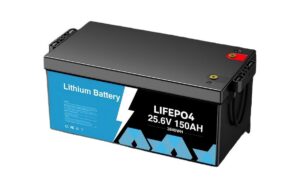
| 24V 100Ah LiFePO4 | 2,560Wh | 2,050Wh at 80% | about 22kg | 24V inverter loads |
Payload matters as much as capacity. A 200Ah lithium pack saves about 38kg against a 200Ah AGM bank, which is weight that can go into water, food or another fridge. Check the van’s aggregate trailer mass and ball weight before mounting the pack, and keep it low and near the axle.
The Ah to kWh calculator converts any bank to watt-hours, the 12V lithium battery line lists the case options, and the 100Ah LiFePO4 battery guide covers runtime examples for a single pack.
Solar has to replace the daily load
A 400W array produces about 1.2kWh to 1.6kWh per day in good sun, which covers a moderate caravan load with little margin. A 200W panel produces about 0.6kWh to 0.8kWh over four peak sun hours, after a 75% derate for heat, wiring and controller losses. A 600W array produces about 1.8kWh to 2.4kWh and gives the bank room to recover after a cloudy day.
| Solar array | MPPT controller | Daily yield at four peak sun hours | Where it fits |
|---|---|---|---|
| 200W | 20A | 0.6kWh to 0.8kWh | Weekend trips, small fridge |
| 400W | 30A | 1.2kWh to 1.6kWh | Week-long free camping |
| 600W | 40A | 1.8kWh to 2.4kWh | Full-time travel, inverter loads |
Yields assume four peak sun hours and a 75% derate. Summer in northern Australia produces more, and southern winter produces less. Panel angle, shade and dust change the number by more than the panel label suggests.
The DC-DC charger stabilises voltage from the tow vehicle
The Anderson plug carries whatever voltage the tow vehicle produces, and that number moves with alternator load and battery state. A DC-DC charger accepts the range, holds the lithium profile and limits current so the alternator is not overloaded. Size it at 20A to 40A for a 100Ah to 200Ah bank, and match the input cable and fuse to the charger’s input current.
The 50A Anderson plug is a connector rating, not a guarantee that 50A reaches the battery. Cable length, plug condition and the charger’s input limit all reduce the real current. A 20A charger on a long run can deliver more useful charge than a 50A connector fed by undersized cable.
A separate RV lithium battery upgrade checklist covers the charger and alternator checks for a caravan or camper.
A 3-way fridge on 12V is a driving load
A 3-way fridge uses a 120W to 180W heating element on 12V, and many models have no thermostat on that setting. It is built to hold temperature while driving, not to cool a warm fridge from battery power. If the element is fed through the house bank, eight hours at 150W is 1.2kWh, which is more than the usable capacity of a 100Ah lithium pack. A compressor fridge uses a variable-duty compressor and is the better match for a battery bank.
Run a 3-way fridge on gas or 240V at camp where the installation allows it, and on 12V only while the engine is running. Check the van’s wiring before assuming the 12V element is isolated from the house bank when the engine stops.
Heat and cold set the charging window
The 12V LiFePO4 charge window runs from 0°C to 50°C, and an Australian summer can push a sealed battery compartment to that ceiling. The same datasheet lists -20°C to 60°C for discharge. Keep the pack ventilated, shaded and away from heat sources. In southern winters, the BMS blocks charge below 0°C, so a winter trip needs a warmed location or a battery heater.
Cycle life is rated at 25°C and 80% depth of discharge. Heat above that test temperature shortens service life even when the pack stays inside its operating range.
The 240V side belongs to a licensed electrician
Caravan 240V wiring, the inlet, RCD, circuit breakers and earth connection are licensed work. That work also has to meet the local caravan wiring rules. The 12V battery, DC-DC charger and solar controller are often fitted by the van builder or an auto electrician. Keep the AC and DC cable routes separate, and label the inverter output as a second source.
An inverter output is not the same as a shore power inlet. It must not backfeed the inlet. A transfer switch or a listed changeover device keeps the two sources apart.
The RV, van and 4WD battery page lists the 12V and 24V models used in caravan builds.
Frequently asked questions
Start from daily energy use. A weekend van using 1.0kWh per day needs about 1,020Wh usable for one day without charging, which is one 12V 100Ah lithium pack. Add a second pack for two days. A family van using 2.0kWh to 3.0kWh per day needs 200Ah or more, plus 400W to 600W of solar.
Yes, through a DC-DC charger. The Anderson plug alone does not hold a lithium charge profile, and voltage drop over the vehicle wiring limits what reaches the van. Size the charger at 20A to 40A for a 100Ah to 200Ah bank.
About 200W for a 0.7kWh daily load, 400W for 1.4kWh and 600W for 2.1kWh, assuming four peak sun hours and a 75% derate. Shade, cloud and hot panels reduce the yield.
Air conditioning is usually a 240V load. Running it from a battery needs an inverter and a bank sized for the surge, and most caravan 12V systems are not built for that. Use shore power or a generator for air conditioning.
Yes. The 12V LiFePO4 pack charges at 14.6V and floats at 13.5V to 13.8V. A lead-acid charger with a 13.6V top will not complete the absorption stage.
Sources: LINEX 12V 100Ah, 12V 200Ah and 24V 100Ah datasheets (energy, dimensions, weight, charge and discharge current, voltage settings, temperature range and cycle life); LINEX RV, van and 4WD application page (RV loads, charging paths and caravan voltage choice); LINEX battery types and sizes guide (BCI case dimensions); calculated values: usable energy = nominal energy x depth of discharge, daily energy = average watts x hours, solar yield = array watts x four peak sun hours x 0.75. Last updated 2026-10-29.
For the lead-acid replacement path used in North America, read the travel trailer battery upgrade guide. It covers Group 24, 27 and 31 trays, converter settings and 7-pin charging.