Current draw, not thrust, sizes the electrical system
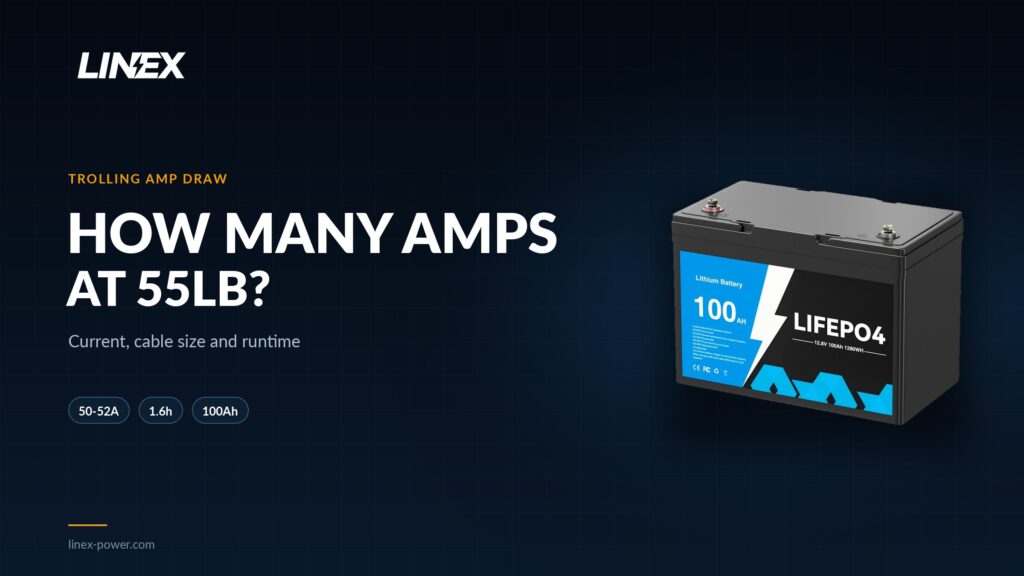
A 55lb thrust motor on a 12V battery pulls about 50A to 52A at full throttle. At 12.8V nominal that is 640W to 666W. Current sets the fuse and cable size, and it decides whether the battery BMS will trip. The figure moves with propeller load, boat weight and water conditions. The product page puts it plainly: “Runtime is set by the motor’s current draw, not by thrust marketing.”
| Thrust | Typical full-throttle current | Power at 12.8V | Runtime on 100Ah at 80% DoD | Runtime at half throttle |
|---|---|---|---|---|
| 30lb | 30A | 384W | 2.7 h | 5 h |
| 40lb | 40A | 512W | 2.0 h | 4 h |
| 50lb | 45A to 50A | 576W to 640W | 1.8 h | 3.5 h |
| 55lb | 50A to 52A | 640W to 666W | 1.6 h | 3.2 h |
The runtime column assumes 1,024Wh usable from a 1,280Wh pack and a steady current at the top of each range. A headwind or a fouled prop pulls the runtime down by 20% to 30%.
Half throttle cuts the draw to about 25A
A 55lb motor at half throttle pulls roughly 25A to 26A, so the same 100Ah battery lasts about 3.2 hours. The runtime table on the product page shows 1.6 hours at full throttle and 3.2 hours at half throttle, which fits a current near half of the full-throttle figure. Propeller efficiency and boat drag decide the exact number, so treat the split as an estimate for trip planning.
A 100Ah battery runs a 55lb motor for 1.6 hours
Usable energy is 1,280Wh x 0.80 = 1,024Wh. Divide by 650W and the runtime is 1.58 hours, which rounds to 1.6 hours. A 12V 150Ah battery gives 1.92kWh nominal, or 1,536Wh usable, for about 2.4 hours. A 12V 200Ah battery gives 2,560Wh nominal, or 2,048Wh usable, for about 3.1 hours. The 200Ah product page lists 3.2 hours at a 50A draw, which is the same arithmetic.
| Battery | Nominal energy | Usable at 80% DoD | Runtime at 650W |
|---|---|---|---|
| 12V 100Ah | 1,280Wh | 1,024Wh | 1.6 h |
| 12V 150Ah | 1,920Wh | 1,536Wh | 2.4 h |
| 12V 200Ah | 2,560Wh | 2,048Wh | 3.1 h |
The 150Ah and 200Ah runtimes are calculated from their datasheet capacities. A 55lb motor does not become more efficient on a larger battery; the larger bank simply holds more usable energy.
Cable and fuse: 25mm² cable and a 125A fuse
At 50A continuous, a 1.5m run of 25mm² copper cable drops about 0.10V, or 0.8% of 12.8V. The trolling battery page specifies 25mm² cable for runs under 1.5m at 100A and a 125A fuse within 30cm of the positive terminal. The fuse protects the cable and the 100A BMS against a short circuit, not the motor’s normal current. Use a DC-rated fuse holder and keep the cable run as short as the locker allows.
| Item | Specification | Why it matters |
|---|---|---|
| Fuse | 125A, within 30cm of the positive terminal | Protects the cable and BMS against a short |
| Cable | 25mm² for runs under 1.5m | Holds voltage drop near 0.1V at 50A |
| Terminals | M8, 8 to 10 Nm | Keeps joints tight under vibration |
| Mounting | Upright, strapped, off the bilge floor | Keeps the case dry and allows heat to escape |
| Environment | Dry locker, spray-resistant case | The case is not designed for submersion |
A 125A fuse looks large next to a 50A motor. It is sized to protect the 25mm² cable and the BMS, which can carry 100A continuously, while still clearing a short circuit before the cable overheats.
A 100A BMS covers the motor, but check the label
The 12V 100Ah trolling model has a 100A continuous BMS rated 1,280W. A 55lb motor at 50A to 52A sits at about half that limit, so it has headroom for startup current and a fouled prop. Some high-thrust 12V motors pull more than 100A at full throttle, and the BMS will trip rather than let the cells overheat. Check the motor’s maximum amp draw on the label or in the manual before ordering.
An 80lb motor needs 24V, not a second 12V unit in series
Most 80lb thrust motors are 24V, not 12V. Doubling the voltage halves the current for the same thrust, so a 24V motor uses thinner cable and a smaller fuse. A single 12V 100Ah battery cannot run a 24V motor. Two 12V units in series can, but only if both are rated for series connection, and this model does not publish a series rating. For a new 24V build, a native 24V pack is the simpler route.
Charging between trips: 5 to 6 hours on a 20A charger
From 80% depth of discharge, a 20A shore charger takes about 5 to 6 hours to refill the 100Ah pack. A 50A charger cuts that to about 2 to 2.5 hours. A 200W solar panel produces 10A to 14A in good sun, which is one to two sunny days. The outboard alternator is a top-up source: small outboards output 6A to 20A and are regulated for lead-acid voltages, so use a DC-DC charger rather than a direct feed.
| Charge source | Current | Time to full from 80% DoD |
|---|---|---|
| Shore charger | 20A | 5 to 6 h |
| Shore charger | 50A | 2 to 2.5 h |
| Solar panel | 10A to 14A | 1 to 2 sunny days |
| Outboard via DC-DC | 6A to 20A | Top-up only |
Charge between 0°C and 50°C. Below freezing the BMS blocks charging to protect the cells, so warm the locker or delay charging until the pack is above 0°C.
What to check before ordering a trolling battery
Match the battery to the motor’s voltage and maximum current, then check the locker dimensions. The 12V 100Ah trolling model is 330 x 310 x 155mm and weighs about 12kg, so it fits lockers that will not take a Group 31 lead-acid block. Keep it out of standing water, strap it down and leave clearance for heat to escape. The 12V 100Ah trolling motor battery page lists the full specification. For the wider range, see the 12V lithium battery line. The trolling motor and fishing application page covers motor sizes, and the trolling motor battery sizing guide walks through 12V, 24V and 36V builds. If you charge from the outboard, the alternator charging guide explains the DC-DC setup. For capacity conversions, the Ah to kWh calculator handles 12V and 24V banks.
Frequently asked questions
About 50A to 52A at full throttle on 12V. At half throttle the draw falls to about 25A to 26A. Check the motor label for the exact figure because prop and load change the current.
About 1.6 hours at full throttle and 3.2 hours at half throttle, assuming 80% depth of discharge and calm water. Wind, current and boat weight move the figure by 20% to 30%.
Yes, if the motor’s maximum current stays below the 100A BMS limit. A 55lb motor at 50A to 52A leaves about half the limit in reserve. Confirm the motor’s peak current before ordering.
A 125A fuse within 30cm of the positive terminal, with 25mm² cable for runs under 1.5m. The fuse protects the cable and BMS, not the motor’s normal 50A draw.
No. Most 80lb motors are 24V. Use a native 24V pack, or two 12V units in series only if both are rated for series connection.
Sources: LINEX 12V 100Ah trolling motor battery page (55lb at 50A to 52A, 1.6 h full throttle, 3.2 h half throttle, 100A BMS, 1,280W, 12kg, 330 x 310 x 155mm, 125A fuse, 25mm² cable, M8 terminals, charging table, checked 2026-11-20); LINEX 12V 150Ah product page (1.92kWh, 15kg, checked 2026-11-20); LINEX 12V 200Ah product page (2,560Wh, 100A, trolling runtime 3.2 h, checked 2026-11-20); LINEX 12V lithium battery range (10Ah to 300Ah, checked 2026-11-20); LINEX trolling motor battery sizing guide (12V, 24V and 36V sizing, checked 2026-11-20); LINEX trolling motor charging from outboard guide (alternator current 6A to 20A, DC-DC charger, checked 2026-11-20); LINEX trolling motor and fishing application page (motor classes, checked 2026-11-20); LINEX Ah to kWh calculator (12V, 24V and 48V, checked 2026-11-20). Last updated 2026-11-20.