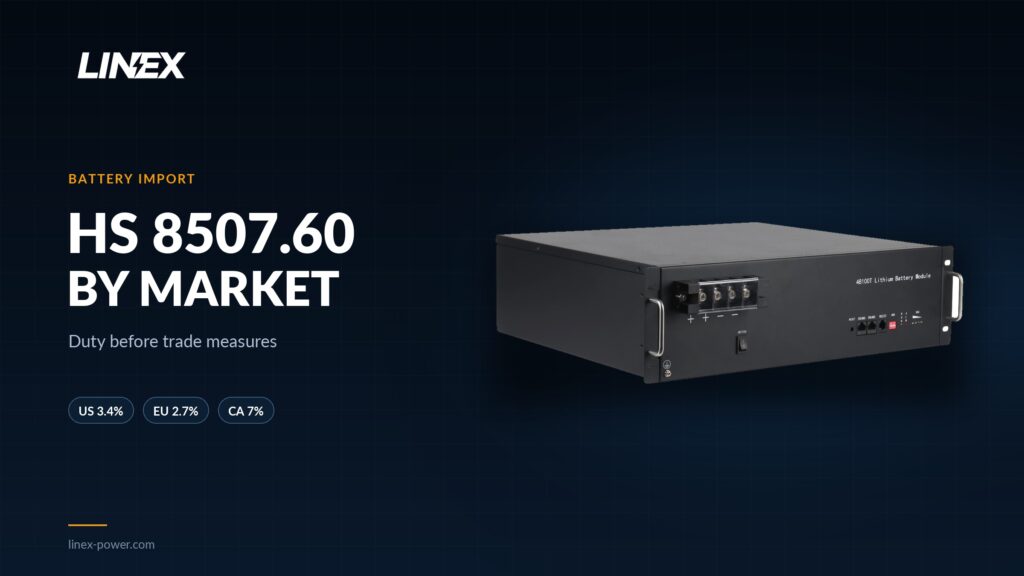
Lithium-ion batteries sit under HS 8507.60
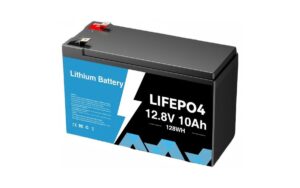
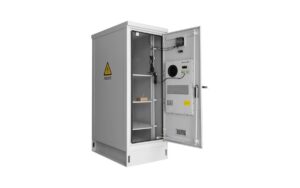
The World Customs Organization heading 8507 covers electric accumulators, and the six-digit subheading 8507.60 covers lithium-ion accumulators, including LiFePO4 packs. A 12V 100Ah LiFePO4 battery, a 48V rack module and a sealed battery energy storage cabinet all start from 8507.60. Lead-acid starting batteries use 8507.10, and other lead-acid batteries use 8507.20.
The code follows the chemistry, not the brand or the case shape. A plastic case, a metal rack enclosure and a BMS do not move a lithium-ion pack out of 8507.60. A separate inverter does, because static converters sit under 8504.40.
| Product | HS heading | Why |
|---|---|---|
| Lead-acid starting battery | 8507.10 | Lead-acid, used for piston engine starting |
| Other lead-acid battery (AGM, gel, flooded deep-cycle) | 8507.20 | Lead-acid, not for starting |
| Lithium-ion battery pack (LiFePO4 included) | 8507.60 | Lithium-ion accumulator |
| Separators and empty battery cases | 8507.90 | Parts of accumulators |
| Inverter or static converter | 8504.40 | Converts DC to AC, not an accumulator |
The same six-digit code covers a 12V 100Ah LiFePO4 battery and a 48V 100Ah telecom battery. The voltage and case change; the heading does not.
The first six digits are global; the national suffix sets the rate
The six-digit code 8507.60 is the same in the US, EU, UK, Canada and Australia, but each market adds its own suffix and duty rate. The US uses 8507.60.00 with statistical suffixes for EV batteries (.10), battery energy storage systems (.30) and other (.90). The EU uses 8507 60 00 90 for other lithium-ion accumulators, the UK uses 8507 60 00 00, Canada uses 8507.60.90 for other, and Australia uses 8507.60.00.
| Market | National code | Base duty | Notes |
|---|---|---|---|
| United States | 8507.60.00 (general) | 3.4% | Statistical suffixes: .10 EV, .30 BESS, .90 other |
| European Union | 8507 60 00 90 | 2.7% | Third-country duty; other EU suffixes cover EV cells |
| United Kingdom | 8507 60 00 00 | 2.0% | Third-country duty |
| Canada | 8507.60.90 | 7% | EV lines 8507.60.10 and .20 are Free |
| Australia | 8507.60.00 | 5% | A Free preferential rate is shown under the CA code |
The national suffix is not cosmetic. The US .30 line lets customs identify a fully encased BESS, while the EU and Canada subdivide 8507.60 by end use. A quote that lists only “HS 8507.60” is enough for a freight forwarder, but not enough to calculate duty. The rate checks come from the USITC HTS, EU TARIC, UK Trade Tariff, CBSA 2026 tariff and ABF Chapter 85.
Base duty ranges from 2.0% to 7% before trade measures
The base rate is 3.4% in the US, 2.7% in the EU, 2.0% in the UK, 7% in Canada and 5% in Australia for the other lithium-ion line. These rates do not include VAT or GST, and they do not include anti-dumping, countervailing or Section 301 duties. A 40ft container of 48V rack modules is cleared on the declared customs value, not on the kWh rating.
China-origin lithium-ion batteries can face additional duties in the US under Section 301. The US HTS general rate for 8507.60.00 is 3.4%, but Chapter 99 headings add duties for specific origins and product lists. The rate and scope change, so check the current Chapter 99 heading for the exact statistical suffix before you book freight. USTR’s Section 301 tariff actions page lists the current measures.
The EU and UK publish their own measure lists. A TARIC or UK Trade Tariff lookup shows the third-country duty, any anti-dumping duty and any suspension for the origin and date. A broker who quotes only the base rate is quoting half the answer.
BESS and battery packs may need a statistical suffix, not a new heading
A battery energy storage system that is fully encased in a housing still enters under 8507.60 in the US, but it uses statistical suffix 8507.60.00.30 instead of .90. The HTS describes the line as “battery energy storage systems fully encased within a housing.” Canada gives a free rate to the EV battery lines 8507.60.10 and .20, while the other line pays 7%.
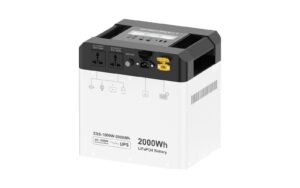
A cabinet with an integrated inverter is a different question. If the inverter gives the unit its essential character, customs may classify it under 8504.40 as a static converter. A battery-only cabinet stays in 8507.60. Ask for a binding ruling when the enclosure combines battery, inverter and controls.
The same logic applies to a 48V rack module with a BMS. The BMS is part of the accumulator, so the module stays in 8507.60. A spare BMS imported on its own is a separate classification question, not a battery pack. For the rack format, the 48V lithium battery line lists the 50Ah to 200Ah modules.
The invoice and the test summary have to match the code
Customs compares the commercial invoice, packing list, UN38.3 test summary and MSDS against the declared code. The invoice should describe the product as lithium-ion accumulators, list the model, voltage, capacity, quantity and unit value, and state the origin. A generic description such as “battery” or “energy storage” invites a query and can delay clearance.
| Document | What it should show | Where it is checked |
|---|---|---|
| Commercial invoice | Product description, model, voltage, capacity, quantity, unit value, origin | Customs entry and duty calculation |
| Packing list | Carton count, gross and net weight, dimensions | Freight and customs inspection |
| UN38.3 test summary | Test report for the cell or battery model | Dangerous goods acceptance |
| MSDS | Chemistry, hazards, transport information | Carrier and customs |
| Declaration of conformity | Applicable standard and responsible party | Market compliance |
| Origin statement | Country of manufacture and preference claim | Duty rate and trade measures |
The lithium battery import guide covers the full document set and shipping sequence. The code and the description have to agree. A 48V 100Ah LiFePO4 module invoiced as a power supply or UPS does not match 8507.60, and the mismatch is easy to spot. The same applies to a battery pack invoiced as cells: the value and the description no longer match the shipment.
Classification traps that change the duty line
Four traps account for many wrong codes: using the lead-acid code for a lithium drop-in, calling a complete pack a battery part, classifying a battery-only cabinet as an inverter, and splitting a pack into cells on the invoice. Each changes the duty line and the documents customs asks for.
| Trap | What it looks like | Correct treatment |
|---|---|---|
| Lead-acid code on a lithium pack | 8507.20 used for a LiFePO4 drop-in | 8507.60 for lithium-ion |
| Complete pack declared as parts | 8507.90 used for a pack with cells and BMS | 8507.60 when the pack is the article shipped |
| Battery cabinet declared as inverter | 8504.40 used for a cabinet with no inverter | 8507.60 for a battery-only cabinet |
| Pack split into cells | Invoice lists cells to change the value | Declare the pack as shipped; valuation must match |
A drop-in replacement is a common error because the case looks like the lead-acid battery it replaces. The chemistry decides the heading, not the terminal layout or the group size. A Group 31 lithium battery is still 8507.60, while a Group 31 flooded battery is 8507.20. The lithium battery pack vs cells guide explains what changes when the pack is the article shipped.
How to confirm the code before the container ships
Confirm the code in five steps: match the product to the 8507.60 description, select the national suffix, check the origin-specific measures, compare the invoice description, and ask for a binding ruling if the product combines functions. A broker can do this in a day; a wrong code can hold the container for weeks.
- Match the chemistry and the article shipped to heading 8507.60.
- Select the national suffix for the destination market.
- Check the origin-specific measures in the official tariff.
- Compare the invoice description and value with the code.
- Request a binding ruling for a combined battery and inverter unit.
The HS code does not set the price. It sets the duty line, the documents and the data that customs uses to clear the shipment. A correct code does not reduce a legitimate duty; it prevents a wrong one.
Frequently asked questions
LiFePO4 is a lithium-ion chemistry, so a LiFePO4 battery pack enters under HS 8507.60. The national suffix depends on the market and end use.
Yes. The BMS is part of the accumulator, so a complete pack with cells, BMS and case stays in 8507.60. A spare BMS imported on its own is a separate classification question.
The HTS general rate for 8507.60.00 is 3.4%. China-origin goods can also face Section 301 duties under Chapter 99, so the total rate depends on the current measure and statistical suffix. Check the HTS and the USTR list before booking.
A fully encased BESS still uses 8507.60 in the US, with statistical suffix 8507.60.00.30. A unit with an integrated inverter may be classified under 8504.40, so confirm the architecture and ask for a ruling if needed.
A flooded, gel or AGM marine battery used for house loads enters under 8507.20. A lead-acid battery designed for engine starting uses 8507.10.
The commercial invoice, packing list, UN38.3 test summary, MSDS, declaration of conformity and origin statement should all describe the same product and model. A mismatch between the invoice and the code is a common cause of clearance delays.
Sources: USITC Harmonized Tariff Schedule, 8507.60.00 (general rate 3.4%, statistical suffixes .10 EV, .30 BESS and .90 other, checked 2026-11-23); European Commission TARIC, 8507 60 00 90 (third-country duty 2.7%, checked 2026-11-23); UK Trade Tariff, commodity 8507 60 00 00 (third-country duty 2.0%, checked 2026-11-23); Canada Border Services Agency, Customs Tariff 2026, Chapter 85 (8507.60.90 Other at 7%, checked 2026-11-23); Australian Border Force, Customs Tariff Schedule 3, Chapter 85 (8507.60.00 at 5% with a Free rate under the CA code, checked 2026-11-23); USTR Section 301 tariff actions (China-origin measures, checked 2026-11-23); LINEX lithium battery import guide (documents and shipping, checked 2026-11-23); LINEX 12V 100Ah LiFePO4 product page (12.8V, 100Ah, 1,280Wh, checked 2026-11-23); LINEX 48V 100Ah telecom battery page (48V, 100Ah, 4.8kWh, checked 2026-11-23). Last updated 2026-11-23.