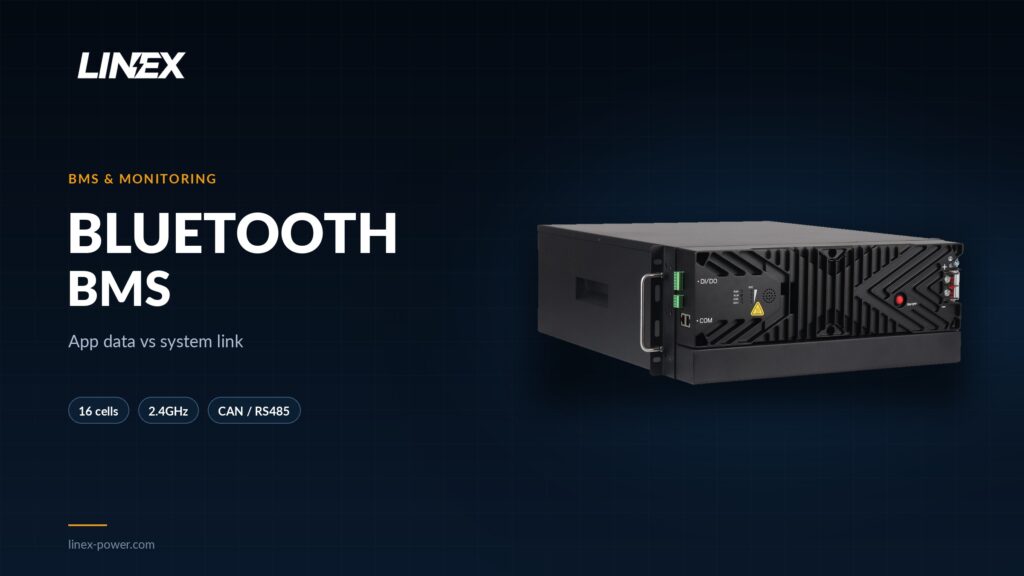
Bluetooth is a data link to the same BMS, not a second protection layer
A Bluetooth BMS uses the same cell monitoring and protection circuit as a wired BMS, with a 2.4GHz radio added for local access. The radio does not change the overvoltage, overcurrent, temperature or short-circuit thresholds. If the app shows a cell at 3.65V and the charge path is still on, the protection logic has a problem that no app setting will fix. Treat Bluetooth as a display and configuration channel, not as a safety upgrade. The LINEX Smart 48V 150Ah lists “BMS protection for temperature, current, short circuit and over-discharge” as its protection set, and that protection runs whether or not a phone is connected.
The app shows cell-level data that a voltmeter cannot
A 16S LiFePO4 pack has 16 cell voltages, and the app lists each one instead of only the 51.2V pack total. The screen also shows temperature, current, state of charge, cycle count and the balance state. A pack that reads 51.2V at rest can still have one cell at 3.05V and another at 3.35V. The total looks normal while the weak cell reaches the cutoff first.
| Reading | Range on a 16S LiFePO4 pack | Why it matters |
|---|---|---|
| Pack voltage | 40.5V cutoff to 58.4V full | Shows charge state and charger behavior |
| Cell voltage | 2.5V BMS cutoff to 3.65V full charge | Finds a weak or unbalanced cell |
| Cell delta | Millivolt difference between highest and lowest cell | Shows whether the balancer is keeping up |
| Temperature | Charge 0°C to 65°C, discharge -20°C to 65°C on the LINEX Smart 48V 150Ah | Shows thermal margin before a shutdown |
| Current | 100A maximum on the LINEX Smart 48V 150Ah | Compares load with the BMS limit |
| Cycle count | 6,000 cycles at 80% depth of discharge on the same model | Tracks aging against the warranty |
Commissioning is the strongest use case
Bluetooth earns its cost at commissioning because the installer can see the cell delta before the battery is closed into a cabinet. Load a 100Ah pack at 20A for 10 minutes and compare the cell voltages under load. A cell that falls below the others under the same load is a weak cell, even if the pack total looks fine. Record the baseline: cell delta, temperature, firmware version and cycle count. That record makes the next service visit a comparison instead of a guess.
Fault finding: read the alarm before opening the case
A Bluetooth BMS turns a shutdown into a readable event: the app keeps the alarm code, the cell that triggered it and the temperature at the time. The table below maps common symptoms to the reading that identifies them.
| Symptom | App reading | Likely cause |
|---|---|---|
| Pack cuts off under load | One cell hits 2.5V while the others are above 3.0V | Weak cell or an unbalanced pack |
| Charger stops early | One cell reaches 3.65V while the pack is at 54.8V | Cell imbalance or a charger set above the pack profile |
| Runtime drops | Cycle count high and cell delta widens under load | Aging, a loose busbar or a failing cell |
| BMS shuts down at high current | Current spike above 100A | Load startup or a pack sized below the load |
| App cannot connect | Pack voltage present but no radio data | Radio module, app or pairing issue, not proof of BMS protection |
Range, metal cases and standby draw are the real limits
Bluetooth uses 2.4GHz radio, and the usual class 2 link reaches about 10m in open air. A sealed metal battery box can cut that to a few meters or block it completely. That is why some installers keep the app connected while the lid is open, or ask for an external antenna option. Standby draw is the other tradeoff: a radio that stays discoverable uses current, so a pack stored for months should be checked and recharged rather than left with the app polling. The drain is small against a 100Ah pack, but it is not zero.
CAN and RS485 still own the system link
A Bluetooth app is a local, one-phone link. CAN and RS485 are the wired links that let an inverter, rectifier or site controller read the battery in real time. The LINEX Smart 48V 150Ah publishes CAN and RS485, 100A charge and discharge at 25°C, 7.2kWh and a 6,000-cycle rating at 80% depth of discharge. A phone can show one pack at a time. A site controller can poll every pack, log alarms and stop the charger before the next cell reaches the cutoff.
| Item | Bluetooth | CAN or RS485 |
|---|---|---|
| Range | About 10m in open air, less through a metal case | Cable length set by the site wiring |
| Users | One phone or tablet at a time | Inverter, rectifier or site controller |
| Data | Cell voltages, temperature, current, state of charge, cycle count | Limits, alarms and control registers |
| Typical use | Commissioning, service and rental handover | Continuous operation and remote monitoring |
| Security | Pairing code and app authentication | Wired link behind the site network |
When Bluetooth is worth the cost, and when it is not
Bluetooth is worth paying for when a person is standing at the battery and needs cell-level data: commissioning, RV and camper builds, rental handovers and dealer service. It is a gimmick when the battery sits in a sealed outdoor cabinet, when the site already has CAN or RS485 to a controller, or when the app has no export or alarm log.
| Use case | What Bluetooth adds | Verdict |
|---|---|---|
| RV or camper build | Cell delta and charger settings at the battery | Worth it |
| Dealer commissioning | Baseline record for the warranty file | Worth it |
| Rental handover | Quick state check before the unit leaves | Worth it |
| Sealed telecom cabinet | Data is already on CAN or RS485 | Gimmick |
| Utility-scale ESS | Site controller and SCADA are the required path | Gimmick |
| Low-cost 12V pack | Added cost with no alarm history | Gimmick |
What to ask before ordering a Bluetooth BMS
Ask for five items before you pay for the option: the radio protocol, the app name and version, the data it exports, the standby current and the firmware update path. A BMS that only shows a state-of-charge bar is not worth a premium. A BMS that logs cell delta and alarm history is. Confirm that the Bluetooth module is inside the BMS and covered by the same warranty, not a separate dongle that can be lost.
Where the LINEX 48V modules fit
The LINEX Smart 48V 150Ah is a 7.2kWh rack module with CAN and RS485, 100A charge and discharge at 25°C, a 53.3V equalization setting, 51.0V float, 40.5V cutoff and a 6,000-cycle rating at 80% depth of discharge. The standard model does not publish a Bluetooth radio, so a project that needs a local radio should confirm the option with LINEX before ordering. For a BMS checklist before ordering, see the battery management system guide. The 48V lithium battery range lists the rack and pole formats, and the 48V 100Ah rack page and pole-mounted 48V 50Ah page publish the communication and protection options. For bank wiring, the series vs parallel guide covers fusing and current sharing.
Frequently asked questions
The radio still draws a small standby current, even when the app is closed. The drain is small against a 100Ah pack but not zero, so a pack in storage should be charged every few months. Ask the supplier for the standby current before leaving a Bluetooth pack unattended for a year.
No. Bluetooth is a local point-to-point link for one phone or tablet. CAN and RS485 are the wired interfaces that inverters, rectifiers and site controllers use for continuous polling, alarms and control. Use Bluetooth for commissioning and service, and keep the wired link for operation.
Bluetooth uses 2.4GHz radio, and a sealed metal enclosure blocks or attenuates the signal. A class 2 link that reaches about 10m in open air may drop to a few meters or lose connection when the lid is closed. Connect before closing the box, or ask for an external antenna option.
Check the cell delta at rest and under a 20A load on a 100Ah pack, the temperature, the charge and discharge current limits, the firmware version and the cycle count. Record the values so the next service visit has a baseline.
A Bluetooth BMS is a local radio with a pairing process, and the risk depends on the app’s authentication and whether the BMS exposes control writes. For a home or RV pack, use the app’s PIN or pairing code and keep the firmware updated. For a site with remote monitoring, use CAN or RS485 behind the site network, and do not rely on Bluetooth as the only access control.
Sources: LINEX product pages and guides: Smart 48V 150Ah (7.2kWh, 100A charge and discharge, CAN and RS485, 53.3V equalization, 51.0V float, 40.5V cutoff, 6,000 cycles at 80% DoD, 60kg, 442.6 x 550 x 177mm, checked 2026-11-25); 48V 100Ah (4.8kWh, 100A charge and discharge, RS485 and RS232, 43kg, 442 x 420 x 133mm, checked 2026-11-25); pole-mounted 48V 50Ah (2.4kWh, 16 cells, IP65, RS485 and RS232, 22.2kg, checked 2026-11-25); 48V 150Ah (7.2kWh, 150A charge and discharge, checked 2026-11-25); battery management system guide (BMS ordering checks, checked 2026-11-25). Other references: Wikipedia Battery management system (monitoring of individual cell voltages, temperatures and state of balance, checked 2026-11-25); Wikipedia Bluetooth (2.4GHz, class 2 range up to about 10m, checked 2026-11-25); Wikipedia Lithium iron phosphate battery (3.2V nominal, 3.60V to 3.65V maximum charge voltage, checked 2026-11-25). Last updated 2026-11-25.