OEM and ODM split ownership in different places
An OEM battery project assigns the specification to the buyer and the build to the factory. An ODM project assigns both to the factory, and the buyer licenses a finished design. On a 12V 100Ah LiFePO4 pack, that split decides who signs the drawing for four 3.2V cells and who owns the 100A BMS settings. The LiFePO4 OEM and ODM process sets out the six steps from specification to shipping.
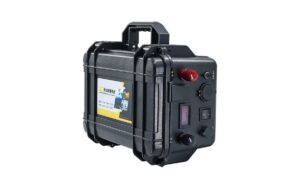
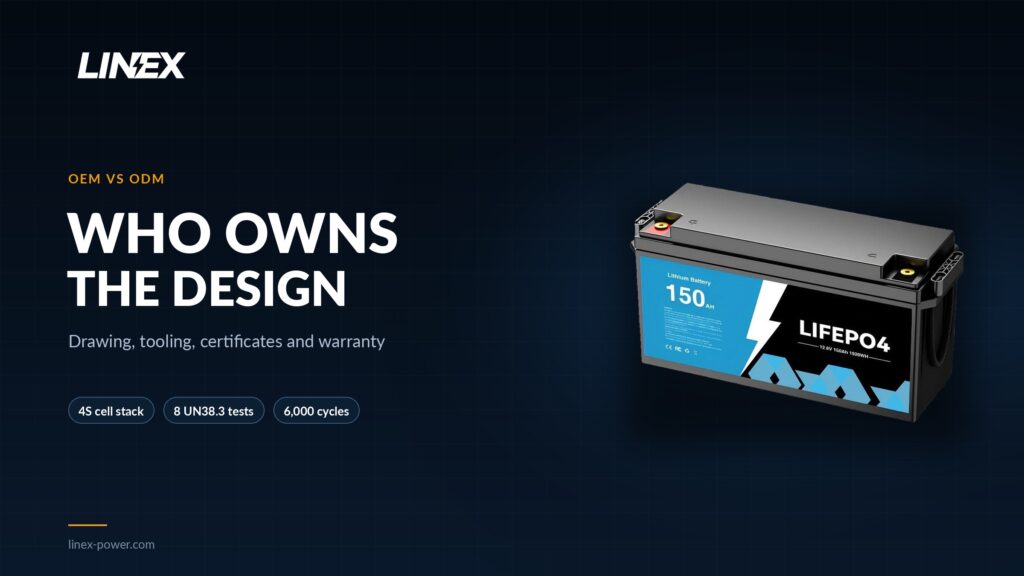
The pack itself is well defined. It stores 1,280Wh, delivers 100A continuous, weighs about 10kg and measures 332 × 172 × 218 mm. An ODM supplier already has that design on file, with a test report and a production history. An OEM buyer can change the BMS, the terminal, the case colour or the label, and each change moves work back to the buyer.
| Dimension | OEM | ODM |
|---|---|---|
| Who writes the specification | Buyer | Factory |
| Who owns the drawing | Buyer, if the contract says so | Factory |
| Tooling | Buyer pays, buyer should own | Factory |
| UN38.3 applicant | Factory, but the model must match | Factory |
| First sample | Built to the buyer’s specification | Standard catalogue unit |
| Warranty path | Buyer to end user, factory to buyer | Factory to buyer |
| Spare parts | Buyer specifies the list | Factory catalogue |
The drawing and the mould decide whether you can move the order
A buyer who does not hold the 2D drawing, the 3D STEP file and the terminal drawing cannot move production to a second factory without starting the design again. The case mould is the hardest item to move. It is cut for one shell, so a 483 × 170 × 240 mm case for a 12V 150Ah pack cannot be reused for a different shell size or cell arrangement.
Put four documents in the OEM contract: the drawing with tolerances, the bill of materials with the cell brand and grade, the BMS parameter list, and the tooling ownership clause. The clause should name who paid for the mould, where it is stored, and who may collect it if the relationship ends. A factory that will not sign that clause is telling you the mould is theirs.
| Item | What it fixes | Who should hold it |
|---|---|---|
| 2D drawing | Case dimensions, terminal position, label area | Buyer |
| BOM | Cell brand, grade and BMS model | Buyer |
| BMS parameter file | Current limits, cutoff voltages, protocol | Buyer, with firmware IP noted |
| Mould | Shell geometry and wall thickness | Buyer if the buyer paid |
| Golden sample | Appearance, fit and finish | Both, sealed and signed |
Certification follows the applicant named on the report
A UN38.3 test summary covers one battery model and names an applicant. Eight tests sit behind that summary, from altitude simulation to forced discharge, and a new cell, a new BMS or a new case can take the model outside the tested configuration. The report has to match the product you ship, not the product the factory sells under its own name.
The same logic applies in the EU. The European Commission’s CE marking guidance states that importers or distributors who market products under their own names “take over the manufacturer’s responsibilities.” An ODM buyer who adds a logo is no longer only a reseller for compliance purposes. Check the declaration and the importer block before the first shipment, not after customs asks.
The firmware boundary is separate. The LINEX OEM page puts it plainly: “Firmware remains the BMS supplier’s IP.” A buyer who wants source code is negotiating for something the BMS maker does not sell, so plan for a parameter file and a documented register map instead. The lithium battery import guide lists the transport documents that have to match those names.
| Document | What it should name | Check before the deposit |
|---|---|---|
| UN38.3 test summary | Model, applicant, cell, test date | Model matches the quote |
| MSDS | Chemistry, model or family, revision date | Not a generic file |
| CE declaration | Manufacturer or importer, directives, standards | Your legal entity is correct |
| IEC 62619 report | Model and test lab | Only if the project requires it |
| Packing list | Model, quantity, serial range | Matches the inspection report |
MOQ moves with the number of parts you change
A LiFePO4 MOQ is a set of minimums attached to parts, not one number for the supplier. A label change on a 12V 100Ah pack keeps four cells, one BMS and one test file, so only the print run is new. A new enclosure needs a mould, a trial shot, a fit check and probably a new UN38.3 configuration review, which is why it carries the largest minimum.
A BMS change sits in the middle. The shell stays, but the parameters, the connector and the test evidence change. Ask for the minimum in writing, per model and per change, and ask which parts are shared with the standard build. A supplier who answers with one catalogue number has not costed your configuration.
| Change | What it triggers | Effect on MOQ | Effect on test evidence |
|---|---|---|---|
| Label | Artwork and print setup | Smallest | None, if the model code is unchanged |
| Carton | Print run and drop test | Small | None |
| Terminal or connector | Harness and torque check | Medium | New pack photos and checklist |
| BMS | Parameter file and firmware validation | Medium | New current and cutoff verification |
| Case | Mould, trial and fit check | Largest | New UN38.3 configuration review |
OEM adds a validation stage that ODM skips
An OEM order needs a golden sample, a pilot batch and a test report written against the specification. The sample test should record capacity at 0.5C, internal resistance, cell balance after a full charge, the BMS cutoff points and the charge profile at 14.6V. Those results belong in the purchase order, not in a chat thread.
A 6,000-cycle rating on a LiFePO4 pack is a design claim measured at 25°C and 80% depth of discharge. A sample test cannot prove 6,000 cycles. It can prove that the batch meets its rated capacity and that the BMS protects the cells at the stated limits, which is what the first container depends on.
| Test | Method | Pass criterion |
|---|---|---|
| Capacity | Discharge at 0.5C from full to cutoff at 25°C | At least 95% of rated Ah |
| Internal resistance | AC or DC measurement at 25°C | Within the datasheet value |
| Cell balance | Measure each group after a full charge | Delta inside the supplier limit |
| BMS cutoff | Trigger overcharge, overdischarge and short circuit | Cutoff and recovery match the datasheet |
| Charge profile | Charge at 14.6V absorption | Current tapers, float holds 13.5V to 13.8V |
ODM is faster, and the limits appear later
An ODM project ships a design that already has a test file and a production history, so the sample stage is short. A 48V 100Ah module arrives with its 100A BMS and 3U case already validated. The trade is control: the buyer cannot change the cell, the BMS firmware, the case or the terminal without turning the project into an OEM one, and the factory’s roadmap decides when the model is discontinued.
That matters for spare parts. A 48V 100Ah rack module is 4.8kWh in a 3U case and weighs 43kg. If the model changes, the replacement may not fit the same rack space or share the same communication register map. Ask for a written spare-parts commitment that covers the warranty period, and check whether the BMS protocol is documented well enough for a third-party monitor.
A handover checklist for the first OEM order
The first OEM order should close with a document pack, not a handshake. Ten items cover most of the risk: signed drawing, BOM with cell brand and grade, BMS model and parameter file, UN38.3 summary for the exact model, CE declaration with the correct legal entity, golden sample photos, packaging artwork approval, tooling ownership clause, warranty terms and a spare-parts list.
Add a change-control clause. Any change to the cell, the BMS, the case or the terminal should trigger a written notice, a new sample and a decision on whether the test report still covers the product. That clause is what keeps the second container identical to the first. The lithium battery manufacturer guide covers the supplier checks that sit around the same contract.
Frequently asked questions
Not automatically. ODM spreads the design cost across the factory’s existing volume, so the unit price starts lower. OEM adds tooling, sample and test work, but the buyer owns the design and can move it. Compare the cost over the warranty period, not the first invoice.
Whoever pays for it should own it, and the contract should say so. Ask for the mould number, the storage location and a clause that lets you collect it. Without that clause, the tool stays with the factory even when you paid for it.
Yes, but check three items first: the model code on the UN38.3 summary, the CE declaration and the importer block. A new brand name can make you the manufacturer of record in the EU, with the obligations that follow.
A label alone usually does not change the battery design, but the model designation on the report must still match the product. Confirm with the test lab before printing, and keep the model code stable across orders.
The clock starts when the specification is signed, not when the enquiry arrives. The quotation should state the sample date and the production date separately, and both dates should move if the specification changes after sign-off.
The drawing, the BOM, the BMS parameter file, the test plan, the packaging artwork, the inspection scope, the warranty terms and a change-control clause. A purchase order that lists only model, quantity and price leaves the important terms outside the contract.
Sources: LiFePO4 OEM and ODM process page (six project steps, customisation scope, MOQ drivers, documentation, firmware IP statement); lithium battery manufacturer guide (supplier checks, MOQ practice, payment structure, certificate checks); lithium battery import guide (UN38.3 summary, MSDS, CE and RoHS, packing list); 12V 100Ah product page (1,280Wh, 100A continuous, 332 × 172 × 218 mm, about 10kg, 4S configuration, 6,000 cycles at 80% DoD, 14.6V charge); 12V 150Ah product page (1,920Wh, 483 × 170 × 240 mm, 4S configuration); 48V 100Ah telecom product page (4.8kWh, 43kg, 3U 19-inch rack, RS485 and RS232); battery management system checklist (BMS current, cutoff and balancing checks); warranty policy (five-year terms); LiFePO4 cell verification guide (capacity, internal resistance and cell marking checks); IATA lithium battery shipping guidance (air transport rules and documentation); UN Manual of Tests and Criteria, section 38.3 (eight tests T.1 to T.8); European Commission CE marking guidance for importers and distributors (own-name products take over the manufacturer’s responsibilities). Last updated 2026-11-08.