BESS capacity is sized from delivered kWh, not peak kW
A lithium ion battery storage system is sized from the energy the site draws over a discharge window, measured in kWh at the load. Peak kW decides the inverter and BMS current rating. It does not decide how many cells to buy. The calculation is nominal kWh = delivered AC kWh ÷ (depth of discharge × inverter efficiency × aging reserve).
For 8kWh delivered at 80% depth of discharge, 90% inverter efficiency and a 10% aging reserve, nominal capacity is 8 ÷ 0.648 = 12.35kWh. A 10kW peak that lasts 10 minutes adds only 1.67kWh to the load, so it changes the power rating far more than the energy rating. A 3kW load held for four hours adds 12kWh. A bank sized only for peak kW runs out early, and a bank sized only for kWh may trip its BMS on a motor start.
Four derates turn 16.08kWh of nameplate into 10.42kWh delivered
Nameplate capacity is measured at the cell level. The load sees less. Depth of discharge, inverter efficiency and aging each remove a share, and the order does not matter because the factors multiply. The 16.08kWh all-in-one model loses 20% at the BMS cutoff, then 10% in the inverter, then 10% to the aging reserve.
| Step | Factor | Energy left from 16.08kWh |
|---|---|---|
| Nameplate capacity | 1.00 | 16.08kWh |
| Usable at 80% depth of discharge | 0.80 | 12.86kWh |
| After 90% inverter efficiency | 0.72 | 11.58kWh |
| After 10% aging reserve | 0.648 | 10.42kWh |
The 0.648 figure is the overall derate for this configuration. Multiply any nameplate by 0.648 to estimate delivered AC energy. A site that needs 10kWh delivered should not order a 10kWh nameplate; it needs about 15.4kWh of nameplate, because 10 ÷ 0.648 = 15.43kWh.
Usable energy and continuous power set different limits
Two batteries can store the same kWh and still carry different loads. The BMS sets a continuous current, and current multiplied by voltage gives the power ceiling. The 16.08kWh model stores three times the energy of the 5.12kWh model, and its 200A output gives 10.24kW at 51.2V. The smaller model’s 100A output gives 5.12kW.
| Model | Nominal energy | Usable at 80% DoD | Max continuous output | C-rate at max output | Typical use |
|---|---|---|---|---|---|
| All-in-one 51.2V 100Ah | 5.12kWh | 4.10kWh | 5.12kW | 1.00C | Small backup, light daily cycling |
| All-in-one 51.2V 206Ah | 10.55kWh | 8.44kWh | 10.24kW | 0.97C | Whole-home backup |
| All-in-one 51.2V 314Ah | 16.08kWh | 12.86kWh | 10.24kW | 0.64C | Solar self-consumption, heat pump |
| Wall-mounted 51.2V 104Ah | 5.32kWh | 4.26kWh | 5.12kW | 0.96C | Wall mount, tight floor space |
| Rack 48V 100Ah | 4.80kWh | 3.84kWh | 4.80kW | 1.00C | 19-inch rack |
| Rack 48V 200Ah | 9.60kWh | 7.68kWh | 4.80kW | 0.50C | Long backup at moderate load |
A 5kW load is 0.98C on the 5.12kWh unit and 0.31C on the 16.08kWh unit. Both are inside the continuous rating, but the small unit has no headroom for a pump start, and its datasheet publishes no peak current. The larger unit leaves room for surge and runs at a lower temperature. For a load that starts motors, ask for the peak current and its duration before choosing the smaller pack.
Backup, solar self-consumption and peak shaving use different load profiles
A backup BESS is sized on essential loads and outage hours. A solar self-consumption BESS is sized on nightly consumption and the share of PV the owner wants to keep. A peak-shaving BESS is sized on the kW gap between the site peak and a target ceiling, multiplied by the minutes that gap lasts. One 10kWh pack can be right for one duty and wrong for another.
| Duty | Sizing input | Formula | Example |
|---|---|---|---|
| Backup | Essential kW and outage hours | kWh = kW × h ÷ (DoD × inverter efficiency × aging reserve) | 2kW for 4h = 8kWh delivered, 12.3kWh nominal |
| Solar self-consumption | Nightly kWh | kWh = nightly kWh ÷ (DoD × inverter efficiency × aging reserve) | 6kWh nightly = 9.3kWh nominal |
| Peak shaving | kW gap and duration | kWh = kW gap × minutes ÷ 60 ÷ DoD | 40kW gap for 15 minutes = 12.5kWh nominal |
The peak-shaving row does not pass through the inverter, so it divides by depth of discharge only. A 12.5kWh pack with a 40kW output rating can shave a 40kW gap for 15 minutes, but the same pack cannot carry a 40kW backup load for an hour. Confirm which side of the inverter the load sits on before using one formula everywhere.
The enclosure and rack set the maximum bank size
A BESS is not only cells. The 5.12kWh all-in-one measures 550 × 280 × 807mm, the 16.08kWh version measures 550 × 280 × 987mm, and the wall unit measures 410 × 185 × 610mm at 46kg. The 48V 100Ah rack module measures 442 × 420 × 133mm at 43kg. Floor space, wall strength, door width and cable bend radius decide how many units fit before the electrical design does.
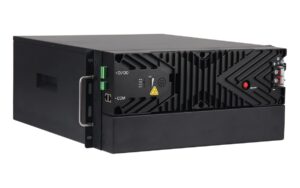
In a 19-inch rack, the 48V 100Ah module is 3U and the 150Ah and 200Ah modules are 4U. A 26U cabinet holds at most eight 100Ah modules, and a practical install is six or seven once a rectifier and distribution take 3U to 6U. The 26U cabinet module count lists the depth and weight checks. The all-in-one is IP41 and the wall unit is IP20, so neither belongs outdoors without a shelter. Confirm service clearance against the installation manual rather than a generic room dimension.
Commissioning compares delivered kWh with the calculated figure
After installation, charge the bank to full and discharge it into a known resistive load. Record the kWh delivered at the load, the starting and ending voltage, and the BMS current log. Compare the result with the 0.648 derate estimate. A small shortfall is normal. A bank that delivers half the estimate has a setting, wiring or current-sharing problem, not a cell problem.
For a 16.08kWh unit, expected delivered energy is about 10.42kWh. A 3kW heater should run for about 3.5 hours before the cutoff, because 10.42 ÷ 3 = 3.47. If it stops after 2.5 hours, check the discharge cutoff, the inverter low-voltage setting and the module balance before blaming the cells.
Frequently asked questions
If 10kWh is delivered AC per day and the bank cycles once, divide by 0.648. The result is 15.4kWh of nameplate. A 16.08kWh all-in-one covers it; a 10.55kWh unit does not.
No. C-rate describes how fast the pack can be discharged relative to its energy. A 1C pack can deliver its full kWh as kW, but it runs hotter and leaves less surge headroom. A 0.5C pack of the same energy delivers half the kW.
No. The inverter rating sets the power ceiling, not the energy. A 5kW load empties the 5.12kWh battery in under an hour, because usable energy at 80% depth of discharge is 4.10kWh.
Nameplate is the cell energy at nominal voltage. Usable capacity is the share the BMS allows before cutoff, which is 80% in these LiFePO4 models. Depth of discharge and inverter losses together leave about 72% of nameplate as delivered AC energy at 90% inverter efficiency.
A 10% reserve is a common design allowance, applied by dividing by 0.9. The 6,000-cycle rating at 80% depth of discharge is a test figure, and actual capacity falls gradually with cycling and temperature.
Only where the product documentation and the inverter support parallel operation. Treat parallel expansion as an engineered configuration and confirm the busbar, breaker and communication settings before connecting a second unit.
Sources: LINEX all-in-one 5/10/16kWh ESS datasheet (5,120Wh, 10,547Wh and 16,077Wh; 100A, 200A and 200A maximum output; 550 × 280 × 807mm and 550 × 280 × 987mm; IP41; -15 to 55°C); LINEX wall-mounted 5kWh ESS datasheet (5,324Wh, 104Ah, 100A maximum, 410 × 185 × 610mm, 46kg, IP20); LINEX 48V 100Ah, 150Ah and 200Ah rack datasheets (4.8kWh, 7.2kWh and 9.6kWh; 100A, 150A and 100A continuous; 3U and 4U; 43kg, 60kg and 78kg); LINEX 26U cabinet article for module count and depth. Derate figures are calculated from the stated assumptions, not datasheet values. Last updated 2026-10-26.
For the bank-level current calculation behind a 48V system, read 48V battery bank sizing for 5kW and 10kW loads. The home energy storage battery supplier page lists the full ESS range, and the all-in-one 5/10/16kWh ESS product page carries the model specifications. For essential-load panels and outage planning, see home battery backup.