A sealed cabinet traps three heat sources
A telecom cabinet gains heat from solar radiation, rectifier and radio equipment, and the batteries themselves. An IP65 shell blocks dust and rain, but it also blocks passive airflow, and the 45mm EPS lining slows heat transfer without removing it. The result is an internal temperature that can sit well above the outside shade temperature.
| Heat source | Where it enters | Design response |
|---|---|---|
| Solar gain | Roof and sun-facing wall | Shade, double roof, light color, insulation |
| Rectifier and radio | Rack equipment | Separate air path, exhaust fan, spacing |
| Battery cycling | Cells and busbars | Current limit, rack spacing, temperature sensor |
| Cable and breaker losses | Terminals and busbars | Correct torque, cable sizing, thermal scan |
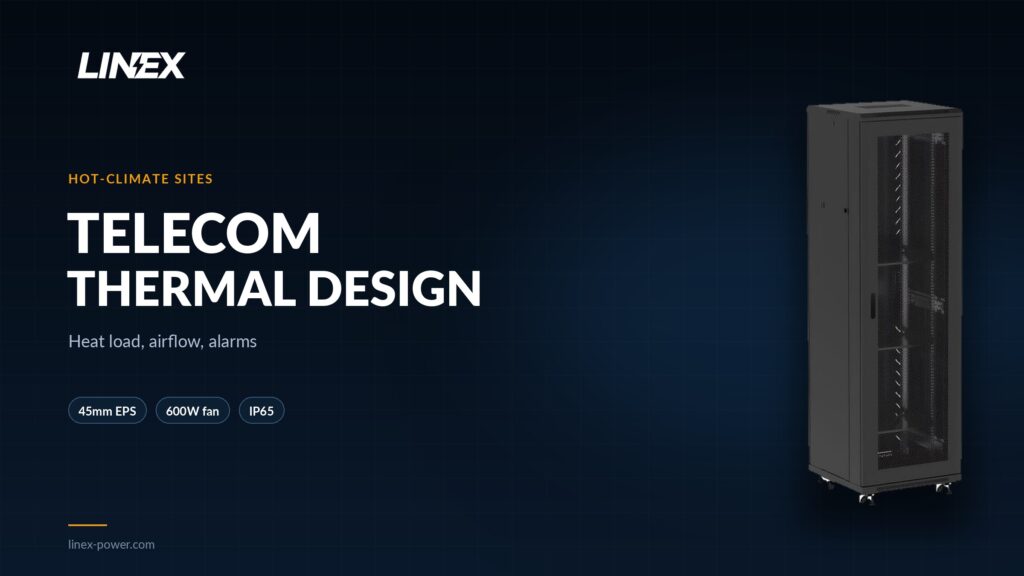
The cabinet datasheet gives the first design number: 45mm of EPS insulation and an IP65 seal. Those two choices protect the equipment from dust and rain, and they also define how much heat the cooling system has to move.
The battery sets the ceiling: 65°C discharge, 65°C charge
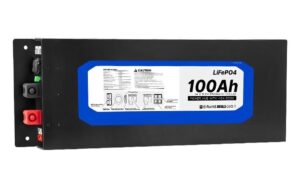
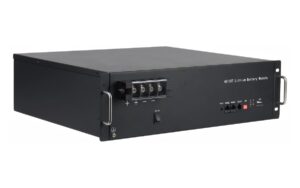
The LINEX 48V telecom modules publish a charge range of 0°C to 65°C and a discharge range of -20°C to 65°C. A cabinet that runs at 55°C leaves 10°C of margin before the BMS reaches its published limit. A pack held near that limit ages faster than one held at 25°C, even though the BMS still allows the load. The temperature range is a protection limit, not a target.
| Model | Energy | Weight | Charge range | Discharge range | Form |
|---|---|---|---|---|---|
| 48V 100Ah | 4.8kWh | 43kg | 0°C to 65°C | -20°C to 65°C | 3U rack |
| 48V 150Ah | 7.2kWh | 60kg | 0°C to 65°C | -20°C to 65°C | Rack |
| 48V 200Ah | 9.6kWh | 78kg | 0°C to 65°C | -20°C to 65°C | Rack |
| Smart 48V 200Ah | 9.6kWh | 82kg | 0°C to 65°C | -20°C to 65°C | Rack |
The pole-mounted 48V 50Ah model lists a different figure: an operating range of -20°C to 60°C and an IP65 case. That makes it a fit for a small cell on a pole, where the battery sits outside the cabinet and sees the same sun and air as the enclosure.
Fan capacity is listed as 600W and 1,500W, not as a room setpoint
The outdoor cabinet datasheet lists a “temperature-controlled exhaust fan (600W for 650mm cabinet, 1500W for ≥750mm cabinet)”. That number describes the fan class, not a promise that the cabinet will hold 35°C in a 45°C yard. Airflow has to move heat out faster than the cabinet gains it, and a clogged filter or a blocked intake cuts the margin.
Use Q = P / (ρ × cp × ΔT) to estimate the air volume. With air at 1.2kg/m³ and 1,005J/kgK, a 600W heat load and a 10K rise need about 179m³/h. The same load at a 15K rise needs about 119m³/h. Those figures are for the air path, before filter resistance and duct losses.
| Heat load | Airflow at 10K rise | Airflow at 15K rise |
|---|---|---|
| 300W | 89m³/h | 60m³/h |
| 600W | 179m³/h | 119m³/h |
| 1,000W | 298m³/h | 199m³/h |
| 1,500W | 448m³/h | 298m³/h |
A fan that moves the right volume at free air may move much less through a dirty filter. Ask for the fan curve at the filter’s pressure drop, not just the free-air rating.
Shade and insulation cut the load before the fan runs
A 45mm EPS lining, a shaded roof and a light outer color reduce solar gain before it reaches the rack. The outdoor cabinet comes in 600 × 450mm and 600 × 600mm footprints with 6U to 26U capacity, so the same cooling kit can sit on very different internal heat loads. Put the cabinet on the shaded side of a wall or under a canopy where the site allows it.
| Measure | What it changes | Limit |
|---|---|---|
| Shade or canopy | Solar gain on roof and wall | Site access and wind loading |
| Double roof or air gap | Radiant heat through the top | Cabinet height |
| 45mm EPS lining | Conducted heat through the walls | Takes internal space |
| Light color or reflective coating | Absorbed solar radiation | Local visual rules |
| Sealed cable glands | Humid air entry | Gland size and count |
Insulation cuts the heat that enters, but it also slows the heat that leaves when the equipment is running. A heavily insulated cabinet needs a controlled air path, not just a bigger fan.
Active cooling: fan, heat exchanger or air conditioner
A filtered fan is the lowest-power option at 45°C, an air-to-air heat exchanger keeps the cabinet sealed, and a cabinet air conditioner is the only one that can hold an internal setpoint below the outside ambient. The choice follows the site: a shaded 35°C cabinet with 300W of equipment behaves differently from a 45°C container yard with 1,500W of load.
| Option | How it works | Best fit | Power and service | IP effect |
|---|---|---|---|---|
| Filtered fan | Moves outside air through filters | Ambient below target, low dust | Fan power plus filter changes | Needs a sealed fan kit to keep IP65 |
| Air-to-air heat exchanger | Transfers heat through a core | Sealed cabinet, outside cooler | Low power, core cleaning | Keeps the shell closed |
| Cabinet air conditioner | Refrigerant cycle | Ambient above target, high heat load | Highest power, filter and condensate service | Keeps IP65 with a sealed unit |
| Thermoelectric cooler | Peltier element | Small loads, moderate ambient | Low efficiency at high ΔT | Sealed, limited capacity |
For a hot, dusty site, the filter change interval matters as much as the fan size. A 600W fan that runs with a blocked filter is a 0W fan with a temperature alarm.
Place the battery low and keep rectifier heat away
Mount the 43kg to 82kg battery modules in the lower rack positions and give the rectifier its own exhaust path. Hot air rises, so the top of a 26U cabinet is the worst place for a pack that already has a 65°C limit. Leave one rack unit between modules when the layout allows it, and put the temperature sensor on the battery busbar, not on the cabinet door.
| Rack zone | Equipment | Thermal reason |
|---|---|---|
| Top | Radio, rectifier exhaust | Hottest air collects here |
| Middle | Rectifier, distribution | Service access and airflow |
| Bottom | Battery modules | Cooler intake air and lower center of gravity |
| Door | Sensor and filter | Measure inlet air, not surface temperature |
A temperature sensor on the door reads the sun, not the cells. Put at least one sensor in the battery compartment and one at the intake, then compare the two.
A 45°C site needs six numbers before cooling is chosen
For a 45°C site, collect the maximum shade ambient, solar exposure, rectifier heat, radio heat, battery heat and the highest internal temperature the BMS will accept. A 26U cabinet with four 48V 100Ah modules carries 19.2kWh of battery and 172kg of modules before any rectifier load. The thermal design starts from that equipment list, not from the cabinet size.
| Data point | Example | Why it matters |
|---|---|---|
| Maximum shade ambient | 45°C | Sets the design day |
| Solar exposure | West wall, no shade | Adds radiant load |
| Rectifier heat | 300W | Continuous internal load |
| Radio heat | 200W | Continuous internal load |
| Battery heat | 100W | Charge and discharge losses |
| Internal target | 35°C | Sets airflow and cooling capacity |
Add the four heat figures, apply a safety margin, and compare the result with the fan or air conditioner capacity at the site’s altitude and filter condition. A design that only works with a clean filter will fail when maintenance slips.
Commissioning checks that catch a thermal problem early
Run the site at full load for two hours and log the battery, intake and exhaust temperatures every 10 minutes. A cabinet that passes at 09:00 can fail at 15:00 when the sun hits the west wall. Check that the fan starts below the alarm threshold, that the filter is clean, and that the battery current stays inside the published 100A or 150A limit.
| Check | Pass condition | Record |
|---|---|---|
| Fan start | Starts before the internal alarm | Start temperature and time |
| Battery temperature | At least 10°C below the BMS limit | Pack and cell temperatures |
| Intake to exhaust rise | Within the design ΔT | Air temperatures |
| Filter pressure drop | Inside the fan curve | Filter condition and date |
| Current | Within the published charge and discharge limit | Current log |
Commissioning is also the time to set the alarms. Set the first warning at least 10°C below the published 65°C limit and the second trip 5°C below it. Adjust the numbers to the site’s load profile, but do not leave the only alarm at the BMS cutoff.
Where the LINEX cabinet and battery range fit
The outdoor telecom cabinet is a 19-inch, IP65 enclosure in 6U to 26U sizes with 45mm EPS insulation, 600 × 450mm or 600 × 600mm footprints and a temperature-controlled fan option. The telecom battery cabinet supplier page covers enclosure selection, and the telecom remote sites page covers site loads and backup hours. For the battery side, the 48V telecom battery guide explains module choice, and the 48V 100Ah vs 200Ah comparison shows capacity and weight. The pole-mounted 48V 50Ah battery is an IP65 option for small cells.
Frequently asked questions
The LINEX 48V telecom modules list a charge range of 0°C to 65°C and a discharge range of -20°C to 65°C. Those are BMS limits, not operating targets. Keep the battery compartment at least 10°C below the limit where the site allows it, because sustained heat accelerates capacity loss.
A fan can keep an IP65 cabinet cool only if the intake and exhaust use sealed fan kits and filters, and only while the outside air is cooler than the internal target. A fan moves air; it does not refrigerate. In a 45°C yard, a fan cannot hold a 35°C setpoint without a heat exchanger or an air conditioner.
Add the rectifier heat, radio heat, battery heat and solar gain in watts, then apply a safety margin. Use Q = P / (ρ × cp × ΔT) to convert the heat load into airflow. A 600W load with a 10K rise needs about 179m³/h, before filter and duct losses.
A cabinet air conditioner is worth it when the site ambient is above the internal target, when the equipment heat load is high, or when dust and humidity rule out filtered air. It draws more power and needs filter and condensate service. An air-to-air heat exchanger is the lower-power option when the outside air is cooler than the inside target.
Put the battery modules in the lower rack positions, away from the rectifier exhaust, and leave one rack unit between modules when the layout allows it. Hot air rises, so the top of the cabinet is the hottest zone. Put the temperature sensor in the battery compartment and a second sensor at the intake.
Set the first warning at least 10°C below the published 65°C limit and the second trip 5°C below it. A warning at 55°C and a trip at 60°C gives the site a chance to react before the BMS cuts the load. Adjust the numbers to the battery model and the site’s load profile.
Sources: LINEX product pages and guides: outdoor telecom cabinet (IP65, 6U to 26U, 600 × 450mm and 600 × 600mm, 45mm EPS, 600W and 1,500W fan options, checked 2026-11-26); 48V 100Ah (4.8kWh, 43kg, 442 × 420 × 133mm, 0°C to 65°C charge, -20°C to 65°C discharge, checked 2026-11-26); 48V 150Ah (7.2kWh, 60kg, checked 2026-11-26); 48V 200Ah (9.6kWh, 78kg, checked 2026-11-26); pole-mounted 48V 50Ah (2.4kWh, 22.2kg, IP65, -20°C to 60°C, checked 2026-11-26); telecom battery cabinet guide (enclosure selection, checked 2026-11-26); Wikipedia Battery thermal management (heat sources and cooling methods, checked 2026-11-26); Wikipedia Base transceiver station (site equipment, checked 2026-11-26); Wikipedia Electrical enclosure (IP ratings, checked 2026-11-26). Last updated 2026-11-26.