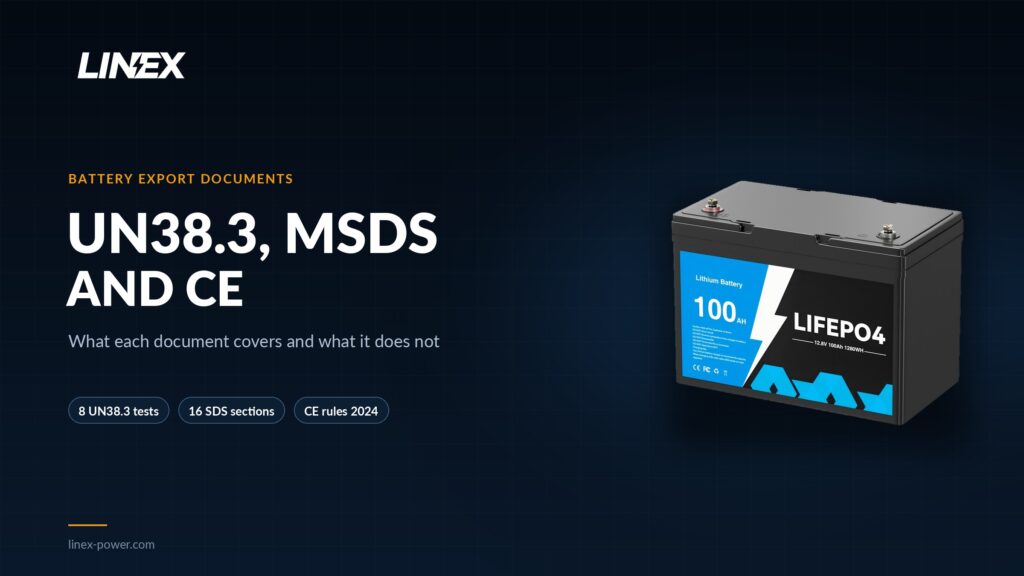
UN38.3 is a test summary with eight tests behind it
UN38.3 comes from section 38.3 of the UN Manual of Tests and Criteria and covers eight tests labelled T.1 to T.8. The file a buyer receives is a test summary, usually one to three pages, not a certificate. It names the cell, the battery model and the applicant, and the test lab that ran the work writes it.
The eight tests cover altitude simulation, thermal cycling, vibration, shock, external short circuit, impact or crush, overcharge and forced discharge. Each one targets a different failure mode, from a swollen cell at low pressure to a separator breakdown after a temperature swing. A summary that says only “UN38.3 passed” without the test list or the model is a cover page, not evidence.
| Test | What it simulates | What it screens out |
|---|---|---|
| T.1 Altitude simulation | Air pressure at 11,000 m | Cell swelling or leakage at altitude |
| T.2 Thermal test | Cycling between -40°C and 75°C | Separator failure after temperature swings |
| T.3 Vibration | Road and sea transport vibration | Loose welds and terminal fatigue |
| T.4 Shock | Drops and handling impacts | Case and internal support damage |
| T.5 External short circuit | A short across the terminals | Overcurrent protection failure |
| T.6 Impact or crush | A crushed cell or pack | Internal short after mechanical damage |
| T.7 Overcharge | Charging past the voltage limit | BMS charge cutoff failure |
| T.8 Forced discharge | Forced current through a discharged cell | Reverse-polarity damage in a series string |
Air carriers require the test summary with lithium battery shipments, and sea carriers now request the same file before they accept a booking.
The summary has to name the model, cell and applicant you ship
A UN38.3 summary covers one cell and one battery design. Change the cell brand, the BMS, the case or the charge voltage and the tested configuration may no longer match the product in the carton. The model code on the summary has to match the model code on the invoice, the packing list and the label on the battery.
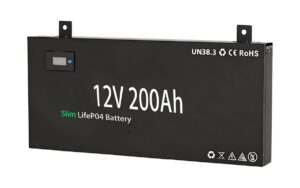
Check three fields before you accept the file: the cell manufacturer and model, the battery model code, and the applicant name. The applicant can be the factory even when the buyer is the importer. What matters is that the applicant’s file covers the product you are buying, not a sister model with a different BMS. On a 12V 100Ah LiFePO4 pack, the summary should name the 4S cell configuration and the 100A BMS, not a 12V 50Ah pack from the same catalogue. The pack stores 1,280Wh, measures 332 × 172 × 218 mm, weighs about 10kg and is rated for 6,000 cycles at 80% depth of discharge.
| Field | What to compare | Common mismatch |
|---|---|---|
| Cell | Manufacturer, model and chemistry on the summary and the BOM | Summary lists a different cell brand |
| Battery model | Model code on summary, invoice, packing list and label | Summary covers a 100Ah pack, shipment is 150Ah |
| BMS | Current limit and cutoff configuration | Summary built with a 50A BMS, order has 100A |
| Applicant | Legal entity named on the report | Applicant is a trading company, not the factory |
| Test date | Date of the report against the last design change | Report predates a cell or case change |
The lithium battery import guide puts the UN38.3 summary at the top of the transport folder for the same reason: a model mismatch stops the booking before anyone looks at the cells.
MSDS is a 16-section safety sheet, not a certificate
A Safety Data Sheet follows the GHS 16-section format: identification, hazard identification, composition, first aid, firefighting, accidental release, handling and storage, exposure controls, physical and chemical properties, stability and reactivity, toxicology, ecology, disposal, transport, regulatory information and revision history. For a battery shipment, section 14 is the one the forwarder reads, because it carries the UN number, proper shipping name, class and packing group.
Section 3 should name the cathode chemistry. A LiFePO4 pack and an NMC pack have different thermal profiles and different hazard data, and a generic sheet that says “lithium ion battery” without a model or chemistry tells the forwarder nothing. Check the revision date as well. A sheet revised in 2019 may predate the current cell, the current BMS and the current case.
| SDS section | What a battery buyer checks |
|---|---|
| 1 Identification | Model or model family, manufacturer and emergency contact |
| 2 Hazard identification | Class 9 transport status and other hazards |
| 3 Composition | Cathode chemistry and cell type |
| 9 Physical properties | Nominal voltage, energy and appearance |
| 14 Transport information | UN number, proper shipping name, class and packing group |
| 15 Regulatory information | Market-specific rules and references |
| 16 Other information | Revision date, version and changes from the last issue |
An MSDS is a communication document. It does not prove that the battery passed a test, and it does not replace the UN38.3 summary. A supplier who sends an MSDS and calls it a certificate has sent one third of the folder.
CE marking is a mark backed by a declaration, not a certificate
Regulation (EU) 2023/1542 replaced Directive 2006/66/EC and has applied since 18 February 2024. Article 17, which sets the conformity assessment route, and Chapter VI, which sets operator obligations, apply from 18 August 2024. Article 20 states: “The CE marking shall be affixed visibly, legibly and indelibly to the battery.” The mark signals that the manufacturer has drawn up an EU declaration of conformity naming the directives and standards it applied.
A battery pack can fall under more than one EU act. The EMC Directive 2014/30/EU can apply where the pack has active electronics such as a BMS. The RoHS Directive 2011/65/EU can apply to the electronics inside the pack. The Low Voltage Directive 2014/35/EU starts at 75V DC, so a 48V nominal pack with a 53.3V charge voltage sits below its scope. An importer that puts its own brand on the battery can take over the manufacturer’s obligations, so the declaration has to name the right legal entity.
| Document | Who issues it | What it proves | What it does not prove |
|---|---|---|---|
| UN38.3 test summary | Test lab or manufacturer | The cell and battery passed the eight transport tests | That the product meets IEC safety or EU market law |
| MSDS | Manufacturer | The chemistry, hazards and transport information | That the battery passed any test |
| EU declaration of conformity | Manufacturer or importer | The battery meets the named directives and standards | That a third party approved the design |
| IEC 62619 report | Test lab | The model passed the industrial safety test | Transport compliance |
| Class 9 declaration | Shipper | The shipment is declared as UN3480 or UN3481 | Product quality |
| Packing list | Shipper | Model, quantity and serial range in the box | That the goods match the documents |
IEC 62619 and IEC 62133 are safety standards, not transport law
IEC 62619 covers safety requirements for industrial lithium cells and batteries, including stationary storage and forklift applications. IEC 62133-2 covers portable sealed lithium cells and batteries. Both are test standards. A CB test certificate can support a CE file, but it does not replace the UN38.3 summary, because UN38.3 is the transport test and IEC 62619 is a product safety test.
A tender may require IEC 62619 for a 48V 100Ah rack module. A carrier will still ask for UN38.3. Keep the two files separate in the document folder, and check that each one names the same model. The battery management system checklist covers the BMS parameters that should appear in the test file.
A document pack that survives customs and a customer audit
The folder should carry six documents: the UN38.3 test summary, the MSDS, the EU declaration of conformity, the IEC report if the buyer requires it, the Class 9 dangerous goods declaration and the packing list. Each one should name the same model code and the same manufacturer. A mismatch between the invoice and the packing list is easier for customs to find than a bad cell.
The Class 9 declaration is the shipper’s document, not the factory’s. It states the UN number, the proper shipping name, the class, the packing group and the packing instruction. For batteries shipped alone the UN number is UN3480; for batteries packed with equipment it is UN3481. A declaration that uses the wrong number stops the booking before the container reaches the port.
Red flags in a supplier’s certificate folder
A single UN38.3 summary shared across five capacities is the clearest warning. The summary covers a model, and a 100Ah pack and a 200Ah pack are different models even when they use the same cell. An MSDS with no chemistry in section 3 is another. So is a “CE certificate” from a consultancy with no standards listed, since CE is a mark backed by a declaration, and the declaration has to name the directive. Watch for an IEC report dated before the last cell or BMS change.
Ask for the native PDF, not a photo of a printed page. Check the report number, the test lab’s scope and the model code. If the supplier cannot explain which cell the report covers, the file is a template. The lithium battery manufacturer guide lists the same checks in the supplier audit.
Frequently asked questions
No. It is a test summary issued against section 38.3 of the UN Manual of Tests and Criteria. It records the tests and the model, and it supports the transport declaration. It is not a product certificate and it does not cover EU market compliance.
The summary has no fixed expiry date, but it stops covering the product when the cell, BMS, case or charge profile changes. Carriers may also ask for a recent copy. Check the test date and the model code, not just the file name.
Sixteen under the GHS format. For a battery shipment, section 14 carries the transport information and section 3 carries the chemistry. A sheet with fewer sections is not in the standard format.
The Battery Regulation (EU) 2023/1542 applies to batteries placed on the EU market, and it requires CE marking. Other directives can apply depending on the pack. Confirm the declaration with your EU importer or a compliance consultant before the first shipment.
UN3480 covers lithium ion batteries shipped alone. UN3481 covers lithium ion batteries packed with equipment or contained in equipment. The packing instruction and the documentation change with the entry.
It is not a transport requirement. Some buyers and tenders require it for industrial batteries, and a CB report can support a CE file. The carrier will still ask for UN38.3.
Sources: UN Manual of Tests and Criteria, section 38.3 (eight tests T.1 to T.8 and the test summary); IATA lithium battery guidance (air transport rules and documentation); Regulation (EU) 2023/1542, Articles 17, 18, 20 and 96 (application from 18 February 2024, Article 17 conformity assessment and Chapter VI operator obligations from 18 August 2024, declaration of conformity); European Commission batteries page (Regulation (EU) 2023/1542 scope); GHS and ISO 11014 (16-section safety data sheet); IEC 62619 (industrial lithium battery safety); IEC 62133-2 (portable sealed lithium batteries); EMC Directive 2014/30/EU; RoHS Directive 2011/65/EU; Low Voltage Directive 2014/35/EU; LINEX lithium battery import guide (transport document set); LINEX 12V 100Ah product page (1,280Wh, 100A BMS, 4S); LINEX 48V 100Ah product page (4.8kWh, 43kg, RS485); LINEX lithium battery manufacturer guide (supplier document checks); LINEX battery management system checklist (BMS parameters). Last updated 2026-11-09.
Related: the LiFePO4 datasheet guide covers the model, cell and test-condition fields that should match the UN38.3 summary.
Related: the battery recycling guide covers EU take-back, the battery passport and damaged-pack transport.