Pole mount keeps 2.4kWh at the radio without a cabinet
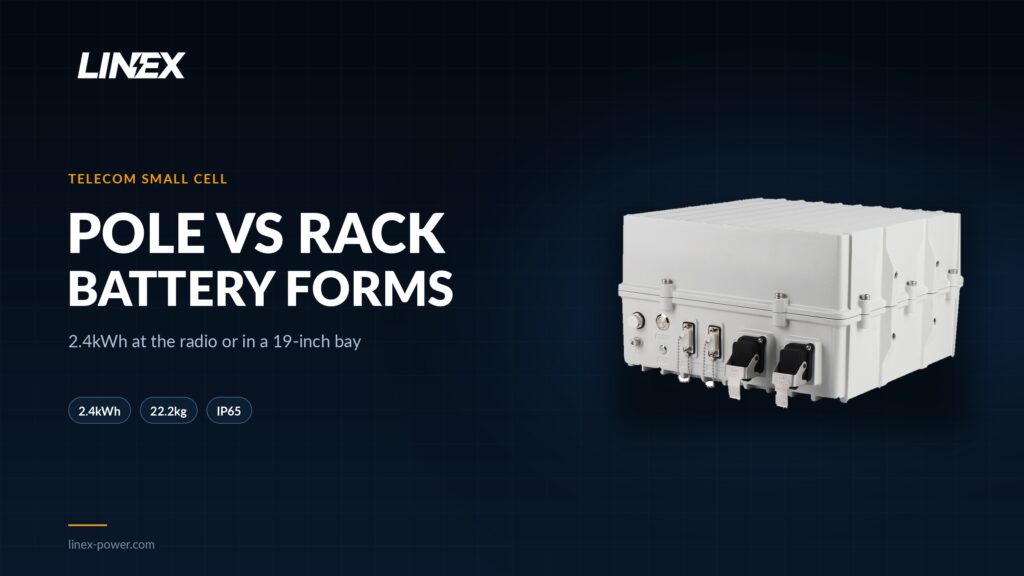
A pole-mounted 48V 50Ah LiFePO4 battery stores 2.4kWh and weighs 22.2kg. The IP65 aluminum case measures 298.3 × 170.2 × 311mm (±1mm), so it mounts on the pole beside an RRU or AAU instead of inside a cabinet. Bottom-panel access keeps the cable entry and service points at the base of the unit.
| Measure | Pole-mounted 48V 50Ah |
|---|---|
| Nominal energy | 2.4kWh |
| Nominal voltage | 48V |
| Case (W × D × H) | 298.3 × 170.2 × 311mm |
| Weight | 22.2kg |
| Protection | IP65 |
| Operating temperature | -20°C to 60°C |
| Communication | RS485, RS232 |
| Cycle life | ≥6,000 cycles |
| Mounting | Pole bracket |
The unit uses 16 LiFePO4 cells, with the BMS and enclosure integrated. Its datasheet lists an operating range of -20°C to 60°C and a storage range of 0°C to 40°C, so a site that bakes in summer needs shade and airflow even though the case is sealed. The datasheet does not publish a continuous discharge current, which is the first number to confirm for a site with a known rectifier load.
Rack modules put the same 2.4kWh in a 19-inch bay
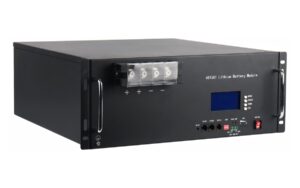
A standard 48V 50Ah rack module also stores 2.4kWh, measures 483 × 325 × 133mm and weighs 29kg. It installs in a 19-inch rack or cabinet and publishes a “50A / 50A @25°C” charge and discharge limit. The same rack format scales to 4.8kWh, 7.2kWh and 9.6kWh with 100Ah, 150Ah and 200Ah modules.
| Rack module | Nominal energy | Case (W × D × H) | Weight | Max charge / discharge |
|---|---|---|---|---|
| 48V 50Ah | 2.4kWh | 483 × 325 × 133mm | 29kg | 50A / 50A |
| 48V 100Ah | 4.8kWh | 442 × 420 × 133mm (482mm with handles) | 43kg | 100A / 100A |
| 48V 150Ah | 7.2kWh | 482 × 440 × 178mm | 60kg | 150A / 150A |
| 48V 200Ah | 9.6kWh | 482 × 610 × 178mm | 78kg | 100A / 100A |
The 200Ah module is not the highest-current module in the family. Its published limit is 100A, the same as the 100Ah model, while the 150Ah module lists 150A. Capacity and current are separate columns, and the BMS decides the second one. A 48V 200Ah module gives 9.6kWh of energy at about 4.8kW continuous at 48V nominal, while the 150Ah gives 7.2kWh at about 7.2kW continuous.
Backup time follows usable energy, not the form factor
At 300W of site load, a 2.4kWh pack delivers about 6.1 hours at 80% depth of discharge and 95% system efficiency. A 4.8kWh pack delivers about 12.2 hours and a 9.6kWh pack about 24.3 hours. The math is the same for a pole unit and a rack module because both start from the same nominal energy.
| Site load | 2.4kWh | 4.8kWh | 7.2kWh | 9.6kWh |
|---|---|---|---|---|
| 150W | 12.2h | 24.3h | 36.5h | 48.6h |
| 300W | 6.1h | 12.2h | 18.2h | 24.3h |
| 500W | 3.6h | 7.3h | 10.9h | 14.6h |
| 750W | 2.4h | 4.9h | 7.3h | 9.7h |
The figures use 80% depth of discharge and 95% efficiency, which leaves 1,824Wh usable from a 2,400Wh pack. Temperature, cable loss and battery age reduce the real number, so add the operator’s reserve on top. The pole unit datasheet does not list a continuous current, so a 750W load needs a factory check even though the energy table suggests 2.4 hours.
Thermal design differs more than the energy rating
The pole unit is sealed to IP65 and rated from -20°C to 60°C, so it sits in the same sun and air as the radio. A rack module needs an enclosure. An indoor cabinet relies on room HVAC and offers IP20 protection, while an outdoor cabinet adds IP65 sealing, 45mm EPS insulation and a temperature-controlled fan rated 600W for a 650mm cabinet or 1,500W for a 750mm cabinet and larger.
| Installation | Enclosure | Protection | Thermal path |
|---|---|---|---|
| Pole unit | Integrated aluminum case | IP65 | Case surface, shade, ambient air |
| Rack in indoor cabinet | 19-inch indoor cabinet | IP20 | Room HVAC and cabinet ventilation |
| Rack in outdoor cabinet | 19-inch outdoor cabinet | IP65 | 45mm EPS, 600W or 1,500W fan |
A sealed outdoor cabinet can still run hotter than the outside air because solar gain, rectifier losses and battery cycling all add heat inside the shell. The battery’s published 0°C to 65°C charge range and -20°C to 65°C discharge range are protection limits, not targets. Heat accelerates aging, so a pack held near 50°C will not last as long as one held near 25°C.
Installation and service access decide the lifecycle cost
A 22.2kg pole unit needs a bracket, pole and fasteners rated for the installed load and local wind, plus cable strain relief and grounding. A rack module weighs 29kg to 78kg, so the shelf or rack must carry that load and leave rear clearance for cables. The easier site to service is usually the one with the lower long-term cost.
| Check | Pole mount | Rack mount |
|---|---|---|
| Structure | Pole bracket | 19-inch rack or shelf |
| Weight per unit | 22.2kg | 29kg to 78kg |
| Cable entry | Bottom panel | Front or rear of rack |
| Service access | Ladder or bucket truck | Cabinet door, standing height |
| Expansion | Parallel pole units | Additional rack modules |
| Environment | Direct sun, rain, wind | Inside cabinet or room |
Pole work needs a safe climbing plan and a mounting height that keeps the unit reachable. Rack work needs a cabinet deep enough for the module and the cable bend, and a shelf that does not sag under 78kg. Neither format is cheaper to install in every case; the site decides which trade is smaller.
Which site type fits which form factor
Use pole mount when the site has no cabinet, the radio is on a pole or wall, and 2.4kWh to 4.8kWh covers the outage. Use rack mount when the site has a 19-inch cabinet or equipment room, the load needs 4.8kWh or more, or the rectifier and monitoring already live in a rack. A site can use both formats, but the two banks should be reviewed as one DC system before they share a bus.
| Site | Form factor | Example capacity | Why |
|---|---|---|---|
| Street pole with RRU, no shelter | Pole 48V 50Ah | 2.4kWh | No cabinet footprint, IP65 case |
| Small cell with 4h backup at 300W | Pole 48V 50Ah | 2.4kWh | 6.1h at 300W |
| Outdoor cabinet, 8h at 500W | Rack 48V 150Ah | 7.2kWh | 10.9h, 19-inch format |
| Indoor equipment room, 12h at 500W | Rack 48V 200Ah | 9.6kWh | 14.6h |
| 10kWh+ site with existing rack | Rack 48V 200Ah × 2 | 19.2kWh | 29.2h at 500W, parallel review |
The table assumes 80% depth of discharge and 95% efficiency. A 4-hour outage at 300W needs 1.2kWh before reserve, so a single 2.4kWh pole unit covers it with margin. An 8-hour outage at 500W needs 4kWh before reserve; the 4.8kWh rack module delivers 3.65kWh usable at that depth and falls short, while the 7.2kWh module delivers 5.47kWh and covers the load.
The IP65 pole-mounted 48V 50Ah battery page lists the full pole unit datasheet. The standard 48V 50Ah rack module and the 48V 100Ah telecom battery pages cover the rack family. For the site-level selection path, see the 48V telecom battery selection guide and the telecom remote site applications page. The telecom battery cabinet guide covers enclosure sizes, and the 26U cabinet sizing article works through the rack count. The thermal management article covers fan sizing in hot climates.
Frequently asked questions
It stores 2.4kWh, which gives about 6.1 hours at 300W and 80% depth of discharge. Check the RRU or AAU load and the required outage hours first, and ask the factory to confirm the continuous current because the pole unit datasheet lists energy and temperature but not a current rating.
About 22.2kg, with a case of 298.3 × 170.2 × 311mm. The pole, bracket and fasteners must support that weight plus wind load, and the cable entry needs strain relief and a drip loop.
Yes, when the cabinet is rated for the site. The rack module itself is not a sealed outdoor enclosure. Use an IP65 cabinet with 45mm EPS insulation and a fan, and check the internal temperature against the battery’s 0°C to 65°C charge range.
The 100Ah module is 3U high, so 26U gives eight modules by height before rails, breakers and cable clearance. Depth matters too: the module is 420mm deep at the case and 482mm with handles and terminals. The cabinet sizing article works through the full count.
The standard 48V rack line lists 53.3V equalization, 51.0V float and 40.5V cutoff. The pole unit datasheet lists RS485 and RS232 communication and BMS protection but not the same voltage table, so confirm the rectifier profile with the factory before commissioning.
Sources: LINEX product pages for the IP65 pole-mounted 48V 50Ah (2.4kWh, 298.3 × 170.2 × 311 ± 1mm, 22.2kg, IP65, -20°C to 60°C, RS485/RS232, ≥6,000 cycles), standard 48V 50Ah (2.4kWh, 483 × 325 × 133mm, 29kg, 50A charge and discharge, 53.3V equalization, 51.0V float, 40.5V cutoff), 48V 100Ah (4.8kWh, 3U, 442 × 420 × 133mm, 43kg, 100A, IP20), 48V 150Ah (7.2kWh, 482 × 440 × 178mm, 60kg, 150A) and 48V 200Ah (9.6kWh, 482 × 610 × 178mm, 78kg, 100A), plus the indoor and outdoor cabinet pages (IP20 10U to 47U; IP65 6U to 26U with 45mm EPS and 600W or 1,500W fan), the 48V telecom battery selection guide and the telecom remote site application page, all checked 2026-11-28. Last updated 2026-11-28.